New York Central Railroad Adirondack Division Historic District

Why it's listed
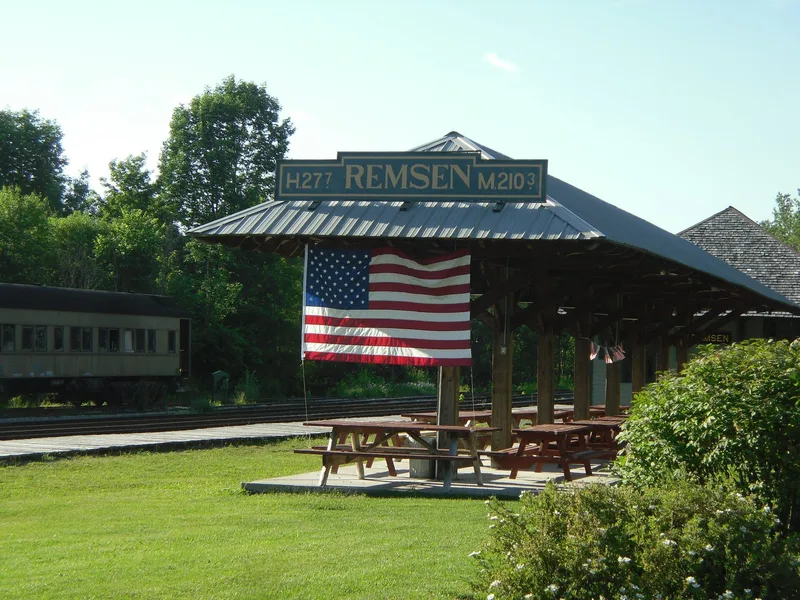
This 118-mile railroad corridor runs from just north of Remsen to Lake Placid, crossing Oneida, Herkimer, Hamilton, St. Lawrence, Franklin and Essex Counties. Built in 1891-92 under William Seward Webb and designed by chief engineer W. N. Roberts, it was completed in about 18 months across difficult terrain. The district includes 23 buildings and 18 structures: wood and stone stations, freight houses, bunkhouses, section foremen's dwellings, a company store and 17 metal bridges on granite or concrete abutments, mostly replaced in 1912-13. The line brought wealthy travelers to the region's private estates and inns, provided the only direct rail link between central New York and Canada, and carried athletes, spectators and boxcars of snow for the 1932 Winter Olympics at Lake Placid. Traffic declined after about 1940. The right-of-way is now vacant and mostly state-owned, and its surviving track, bridges and buildings retain a high degree of integrity.
Machine-generated summary. This summary was generated by a language model from the official nomination document and has not been reviewed line by line by an editor. It may contain errors. Check the source document before relying on any detail. Source: nomination document (PDF) · catalog entry. Generated October 2026 (model claude-sonnet-5-5, prompt v1.0-2026-10-29).
| Period of significance | 1891-ca. 1940 |
|---|---|
| Styles | No style |
| Areas of significance | Transportation, Engineering |
| Acreage | 1144 |
| Boundary source | NPS cultural-resource GIS polygon |
| Full listing page | New York Central Railroad Adirondack Division Historic District (property record) |
What listing means for this property
This is a historic district. Buildings within its boundary are either contributing (they add to the district's significance) or non-contributing. Owners of contributing income-producing buildings can claim the 20% federal rehabilitation tax credit; homeowners should look at state credits. National Register districts impose no design review by themselves; a local historic district ordinance, if one exists, does (the difference explained).
Noted as vacant in the nomination. Nomination documents can be decades old; current status may differ. If you are considering buying an empty listed property, read the due-diligence checklist.
General information, not legal or tax advice. Rules change; confirm with your State Historic Preservation Office or a qualified adviser.