Freer Cottage

Why it's listed
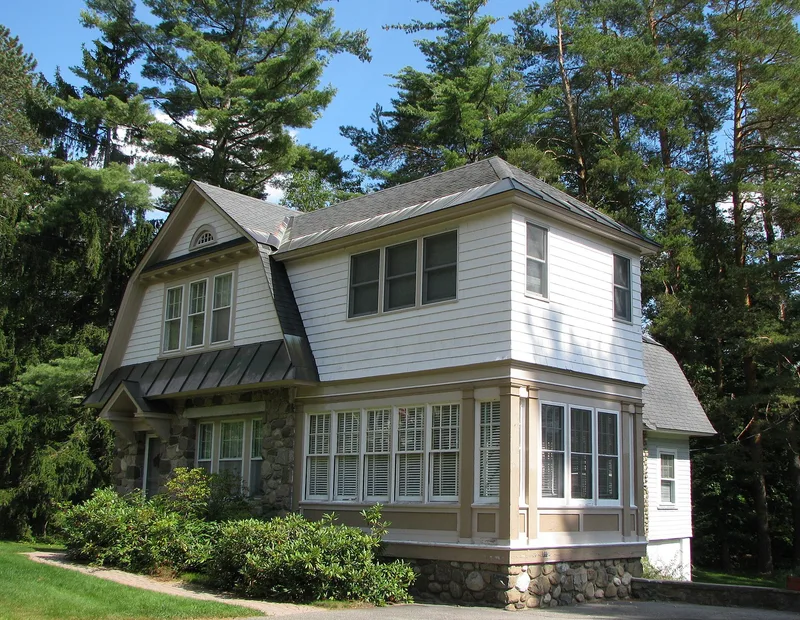
Built before 1925 at 40 Kiwassa Street in Saranac Lake, this one-and-one-half-story Colonial Revival house has a gambrel roof, a fieldstone foundation, a first floor of large fieldstone that shrinks to cobblestone and shingle toward the rear, and cedar-shingled upper walls. Its first owner was John R. Freer, president of the Adirondack National Bank in the 1920s. In 1926 Bettie and Hallie Sutton arrived in the village seeking a cure for Hal Sutton, who had tuberculosis. They rented the house, later bought it, and added a wing with two stacked cure porches, one reached through French doors from the living room and large enough to turn a bed. Hal Sutton died in 1939. The house is recognized as a single-family residence adapted for tuberculosis treatment during the village's second cure-industry boom, and it keeps the porches that mark that role. It stands on the edge of the Glenwood Estates Colony, an upper-class neighborhood begun in 1911.
Significance in brief: It is presented as a representative example of a single-family house adapted for tuberculosis treatment during Saranac Lake's second boom in the cure industry (1918-1939). A wing with two cure porches was added between 1926 and 1939, and these porches retain the features that identify their function. It is also a fine example of a Colonial Revival home adapted to the cure for a single family.
Machine-generated summary. This summary was generated by a language model from the official nomination document and has not been reviewed line by line by an editor. It may contain errors. Check the source document before relying on any detail. Source: nomination document (PDF) · National Archives catalog entry. NRHP reference 92001417, listed November 6, 1992. Summary generated October 2026 (model claude-sonnet-5-5, prompt v1.0-2026-10-29, confidence high).
Key facts
| Address | 40 Kiwassa St., Saranac Lake |
|---|---|
| County | Franklin County |
| Listed | November 6, 1992 |
| Reference number | 92001417 |
| Resource type | Building |
| Period of significance | c.1920-c.1930 |
| Architectural style | Late 19th & 20th Century Revivals: Colonial Revival |
| Criteria |
|
| Areas of significance | Health/Medicine, Architecture |
| Level of significance | Local |
| Status (as stated in the nomination) | Current function is listed as a single dwelling; the cure porches remain intact. |
| Acreage | 0.9 |
| Within district | New York Central Railroad Adirondack Division Historic District |
| Coordinates | 44.31757, -74.13136 (NPS GIS) |
What listing means for this property
National Register listing is honorary for a privately owned home: it does not by itself restrict what an owner may do with their own money, and it does not require public access. Restrictions come from local landmark or historic-district ordinances, which are separate (how they differ).
Owner-occupied houses are not eligible for the 20% federal rehabilitation tax credit, which applies to income-producing buildings, but many states offer credits for homeowners. Listing also opens the door to preservation easements and to buying a plaque. Start with what listing means for homeowners, renovating a listed house and selling one.
General information, not legal or tax advice. Rules change; confirm with your State Historic Preservation Office or a qualified adviser.
Sources and further reading
- National Park Service, National Register of Historic Places database (snapshot May 2026), reference 92001417.
- Nomination form (PDF, National Archives) — catalog entry
- Wikipedia article (used for cross-checking only; text not reproduced here)
- Wikidata Q5501127
- This listing as JSON
Last updated October 2026. Found an error? See the editorial policy for how to report it.