Larom Cottage

Why it's listed
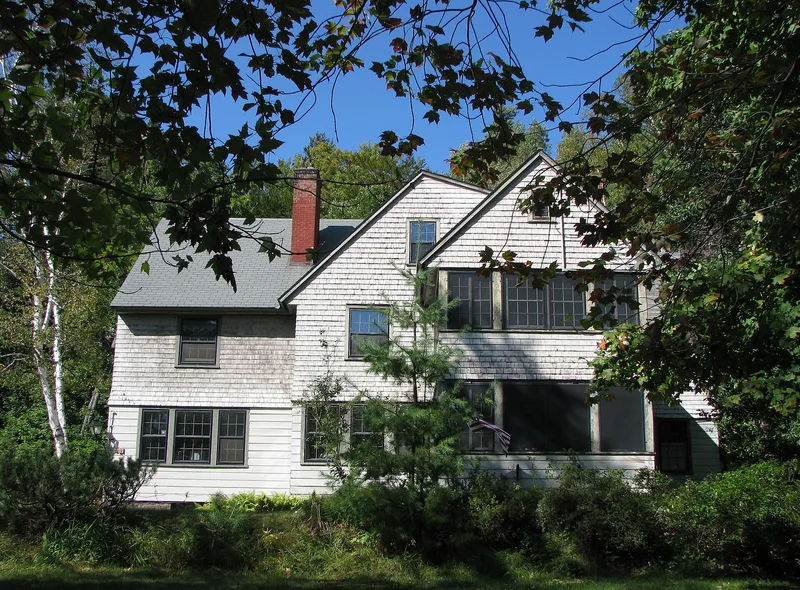
Located on a large wooded lot at 112 Park Avenue in Saranac Lake, this two and one-half story wood frame house was built about 1905-1910 by the Rev. and Mrs. Walter H. Larom. Walter Larom was priest at St. Luke's Episcopal Church. Their property was laid out on the principle of an English estate, with three houses, a tennis court and formal gardens, and two of the houses were rented to tuberculosis patients and their families. Tenants included stockbroker Harris D. Stearns in 1915, and later the family of John Black, who died of the disease. The house rests on a stone foundation, with clapboard on the first floor, shingles above and a gable roof. A glazed first-floor cure porch and a second-story sleeping porch carry the features typical of local cure cottages. It is considered an intact, representative cure cottage, and it retains its original moldings, stair and five fireplaces.
Significance in brief: It is argued to be an intact and representative example of twentieth century residential architecture built for rental to tuberculosis patients and their families during the village's boom period of curing activity. It keeps cure features such as glazed cure and sleeping porches, and has high integrity of design, materials, setting and association.
Machine-generated summary. This summary was generated by a language model from the official nomination document and has not been reviewed line by line by an editor. It may contain errors. Check the source document before relying on any detail. Source: nomination document (PDF) · National Archives catalog entry. NRHP reference 92001428, listed November 6, 1992. Summary generated October 2026 (model claude-sonnet-5-5, prompt v1.0-2026-10-29, confidence high).
Key facts
| Address | 112 Park Ave., Saranac Lake |
|---|---|
| County | Franklin County |
| Listed | November 6, 1992 |
| Reference number | 92001428 |
| Resource type | Building |
| Period of significance | ca.1905-ca.1940 |
| Architectural style | Queen Anne |
| Criteria |
|
| Areas of significance | Health/Medicine, Architecture |
| Level of significance | Local |
| Status (as stated in the nomination) | Still used as a single dwelling; the form describes a high degree of architectural integrity. |
| Acreage | 0.9 |
| Within district | New York Central Railroad Adirondack Division Historic District |
| Coordinates | 44.33384, -74.12786 (NPS GIS) |
What listing means for this property
National Register listing is honorary for a privately owned home: it does not by itself restrict what an owner may do with their own money, and it does not require public access. Restrictions come from local landmark or historic-district ordinances, which are separate (how they differ).
Owner-occupied houses are not eligible for the 20% federal rehabilitation tax credit, which applies to income-producing buildings, but many states offer credits for homeowners. Listing also opens the door to preservation easements and to buying a plaque. Start with what listing means for homeowners, renovating a listed house and selling one.
General information, not legal or tax advice. Rules change; confirm with your State Historic Preservation Office or a qualified adviser.
Sources and further reading
- National Park Service, National Register of Historic Places database (snapshot May 2026), reference 92001428.
- Nomination form (PDF, National Archives) — catalog entry
- Wikipedia article (used for cross-checking only; text not reproduced here)
- Wikidata Q6489738
- This listing as JSON
Last updated October 2026. Found an error? See the editorial policy for how to report it.