Little Red

Why it's listed
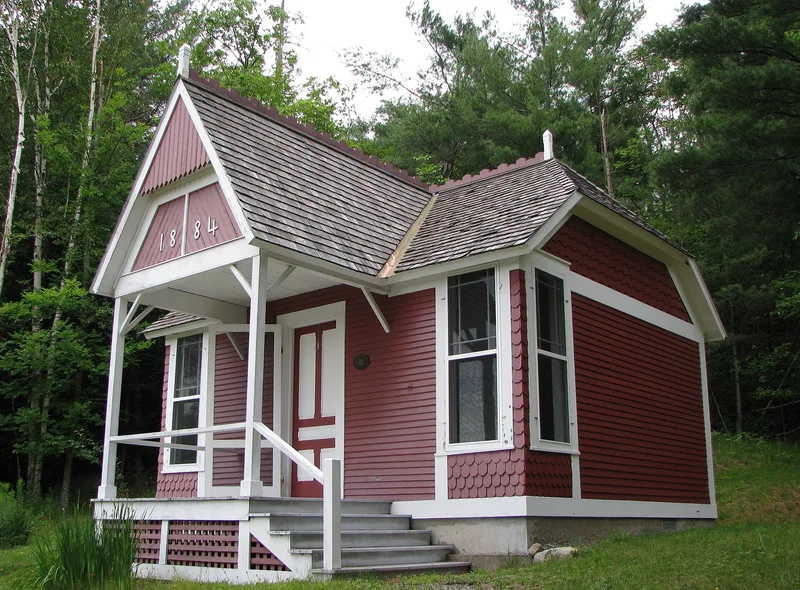
Little Red is a tiny frame cottage, measuring 14 by 18 feet, that now stands on the grounds of the Trudeau Institute off Algonquin Avenue in Saranac Lake. Built between summer 1884 and February 1885, it was the second building of Dr. E.L. Trudeau's Adirondack Cottage Sanitarium and the first cure cottage in the village. Its $350 cost was donated by a Philadelphia benefactor. Alice and Mary Hunt, tuberculous factory workers, were its first patients, and Trudeau urged them to rest outdoors on the small front porch. Both recovered, and the cottage became the national model for cure cottages. It has a jerkin head gable roof of wood shingles, stained clapboard and shingle walls, a central entrance flanked by two windows, and a plain one-room interior. The cottage was moved in 1890, 1920, 1935 and 1964, yet it remains largely intact and now serves as a museum.
Significance in brief: The nomination argues it is the first structure in America built specifically for treating tuberculosis patients and the first cure cottage in Saranac Lake. It became the national model for cure cottages. Despite several moves, it remains virtually intact and keeps the key features of a cure cottage.
Machine-generated summary. This summary was generated by a language model from the official nomination document and has not been reviewed line by line by an editor. It may contain errors. Check the source document before relying on any detail. Source: nomination document (PDF) · National Archives catalog entry. NRHP reference 92001446, listed November 6, 1992. Summary generated October 2026 (model claude-sonnet-5-5, prompt v1.0-2026-10-29, confidence high).
Key facts
| Address | Algonquin Ave., Saranac Lake |
|---|---|
| County | Franklin County |
| Listed | November 6, 1992 |
| Reference number | 92001446 |
| Resource type | Building |
| Period of significance | 1884-1885 |
| Architect / builder | Daniel W. Riddle |
| Architectural style | Mid-19th Century/Gothic Revival; Other: cure cottage |
| Criteria |
|
| Areas of significance | Health/Medicine, Architecture |
| Level of significance | Local |
| Status (as stated in the nomination) | Current function is a museum; the building was moved to its present site in 1964 and is described as virtually intact. |
| Acreage | 0.9 |
| Within district | New York Central Railroad Adirondack Division Historic District |
| Coordinates | 44.31831, -74.15769 (NPS GIS) |
What listing means for this property
National Register listing is honorary: it recognises significance and does not restrict what a private owner may do without federal money or permits. It unlocks the 20% federal rehabilitation tax credit for income-producing buildings, state credits in many states, and Section 106 review when federal agencies are involved. See what listing means in practice.
General information, not legal or tax advice. Rules change; confirm with your State Historic Preservation Office or a qualified adviser.
Sources and further reading
- National Park Service, National Register of Historic Places database (snapshot May 2026), reference 92001446.
- Nomination form (PDF, National Archives) — catalog entry
- Wikipedia article (used for cross-checking only; text not reproduced here)
- Wikidata Q6651480
- This listing as JSON
Last updated October 2026. Found an error? See the editorial policy for how to report it.