Washington Square West Historic District

Why it's listed
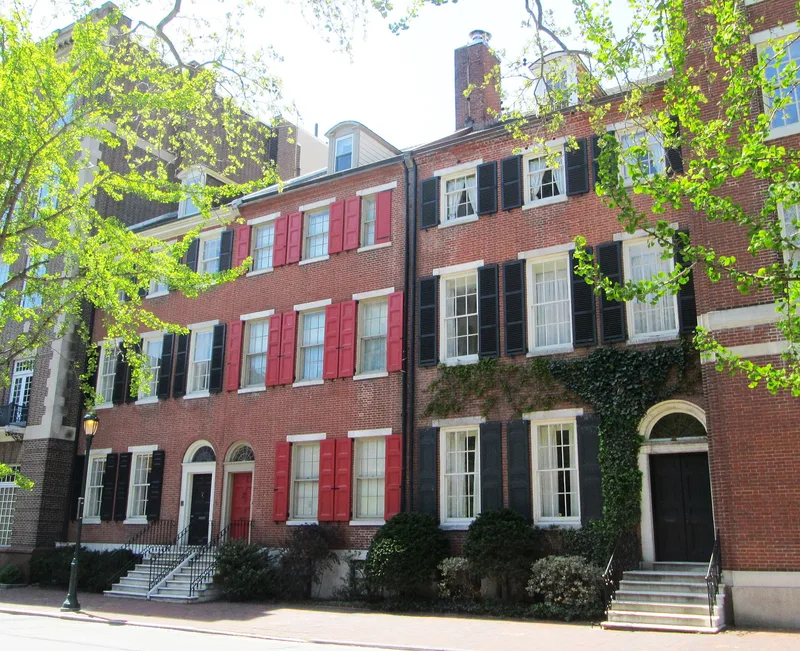
Washington Square West is a historic district of brick rowhouses west of Washington Square in central Philadelphia, with examples built from about 1812 onward. The area is noted for its speculative development, in which entrepreneurs bought large tracts, subdivided them and sold lots to builders who constructed houses under ground rent agreements. Savage and Dugan's Dugan's Row, begun in 1822, and Israel VanHorn's Pine Street development, begun in 1850, are cited as examples. Architect-designed rows include Carolina Row, attributed to Robert Mills, and Portico Row, designed by Thomas U. Walter for John Savage in the 1830s. Over time the district shifted toward commercial, multi-family and institutional uses, with the 900 block of Pine Street becoming an antique center. Its rows are regarded as an early model for the city's later residential neighborhoods.
Machine-generated summary. This summary was generated by a language model from the official nomination document and has not been reviewed line by line by an editor. It may contain errors. Check the source document before relying on any detail. Source: nomination document (PDF) · catalog entry. Generated October 2026 (model claude-haiku-5-5, prompt v1.1-2026-10-29).
| Period of significance | 1800-1899 |
|---|---|
| Styles | Federal, Greek Revival, Italianate, Georgian, Eastlake (as referenced in the district's buildings) |
| Areas of significance | Architecture, Community Planning and Development |
| Acreage | 61 |
| Boundary source | NPS cultural-resource GIS polygon |
| Full listing page | Washington Square West Historic District (property record) |
What listing means for this property
This is a historic district. Buildings within its boundary are either contributing (they add to the district's significance) or non-contributing. Owners of contributing income-producing buildings can claim the 20% federal rehabilitation tax credit; homeowners should look at state credits. National Register districts impose no design review by themselves; a local historic district ordinance, if one exists, does (the difference explained).
General information, not legal or tax advice. Rules change; confirm with your State Historic Preservation Office or a qualified adviser.