Hill-Physick House
Also known as: Hill-Physick-Keith House

Why it's listed
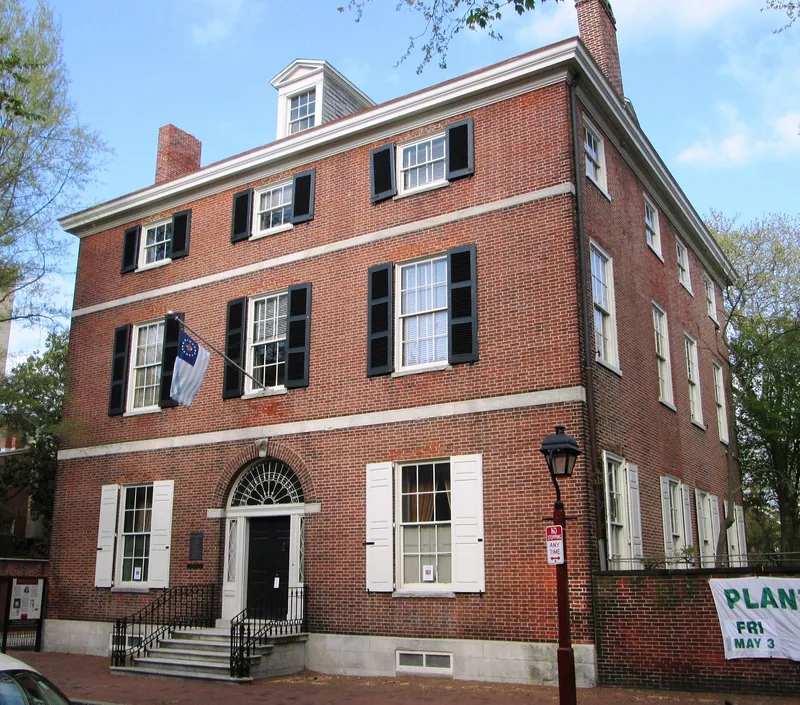
Built about 1786 at 321 South Fourth Street in Philadelphia by Henry Hill, a merchant who had been a justice of the peace and served in the Pennsylvania Assembly and Executive Council. The three-story brick house with an attic has a shingled hip roof, four dormer windows, and a marble-tiled entry hall with a mahogany staircase. Its doorway with fan light and slender side lights is singled out as especially fine. After Hill's death in 1798, the house passed to Dr. Philip Syng Physick, often called the Father of American Surgery, who was known for his surgical instruments and for treating yellow fever patients in 1793. Physick's family kept the house until 1965, when it was sold to the Philadelphia Society for the Preservation of Landmarks. It was restored to its appearance around 1810, and nearly all of its interiors survive intact. The house is significant as an example of late eighteenth-century American architecture and as the home of a major early medical figure.
Significance in brief: The house is noted for its doorway with fan light and side lights and for its largely intact interiors, which represent late eighteenth-century American architecture. Its association with Philip Syng Physick, a leading surgeon of the early American medical profession, adds to its importance.
Machine-generated summary. This summary was generated by a language model from the official nomination document and has not been reviewed line by line by an editor. It may contain errors. Check the source document before relying on any detail. Source: nomination document (PDF) · National Archives catalog entry. NRHP reference 71000726, listed May 27, 1971. Summary generated October 2026 (model claude-haiku-5-5, prompt v1.1-2026-10-29, confidence medium).
Key facts
| Address | 321 S. 4th St., Philadelphia |
|---|---|
| County | Philadelphia |
| Listed | May 27, 1971 |
| Reference number | 71000726 |
| Resource type | Building |
| Period of significance | ca. 1786 |
| Areas of significance | Science, Architecture |
| Level of significance | National |
| National Historic Landmark | Yes, designated January 7, 1976 |
| Status (as stated in the nomination) | Restored 1966-68 for the Philadelphia Society for the Preservation of Landmarks; the coach house was razed due to structural deterioration. |
| Acreage | 0.9 |
| Within district | Society Hill Historic District |
| Coordinates | 39.94426, -75.14828 (NPS GIS) |
What listing means for this property
National Register listing is honorary for a privately owned home: it does not by itself restrict what an owner may do with their own money, and it does not require public access. Restrictions come from local landmark or historic-district ordinances, which are separate (how they differ).
Owner-occupied houses are not eligible for the 20% federal rehabilitation tax credit, which applies to income-producing buildings, but many states offer credits for homeowners. Listing also opens the door to preservation easements and to buying a plaque. Start with what listing means for homeowners, renovating a listed house and selling one.
General information, not legal or tax advice. Rules change; confirm with your State Historic Preservation Office or a qualified adviser.
Sources and further reading
- National Park Service, National Register of Historic Places database (snapshot May 2026), reference 71000726.
- Nomination form (PDF, National Archives) — catalog entry
- Wikipedia article (used for cross-checking only; text not reproduced here)
- Wikidata Q15224026
- This listing as JSON
Last updated October 2026. Found an error? See the editorial policy for how to report it.