New Market
Also known as: Head House Market

Why it's listed
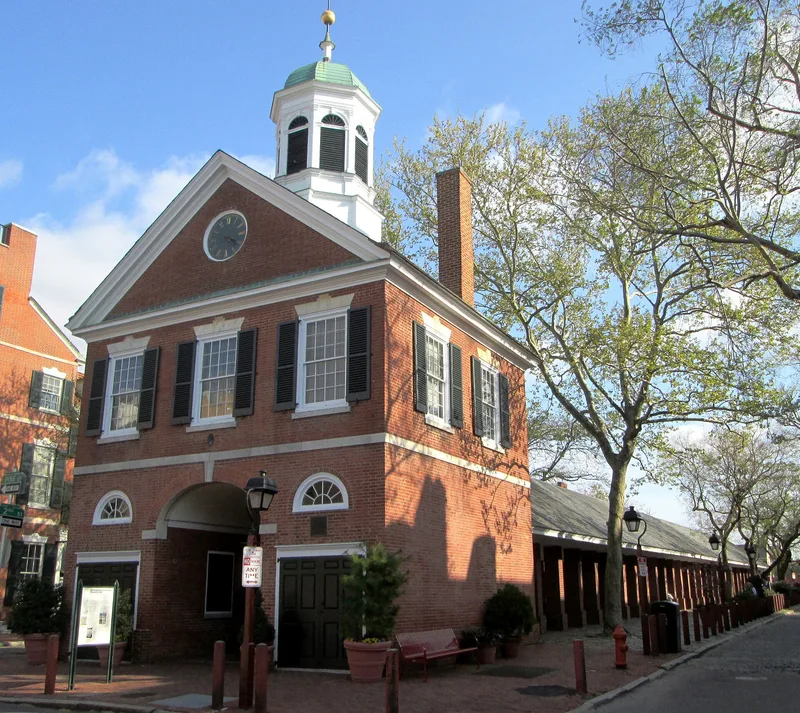
Built in 1745 on South Second Street in Philadelphia, the New Market was a public market of brick piers supporting a gable roof over an arched, plastered ceiling. Private contractors, Edward Shippen and Joseph Wharton, completed its first construction, and the City Council took over its operation in 1772. The market grew over time, reaching Pine Street after an 1809 expansion and adding a brick engine house, the Head House, in 1804. Its southern engine house, built in 1799, was torn down in 1860. Most street markets were abandoned in the nineteenth century, but this one survived, largely because the rents from its stalls continued to bring the city income. The surviving section from Lombard to Pine Street was restored in 1923 and retains 21 original brick piers. The Head House also remains standing. The site is regarded as an example of a once common form of city food distribution.
Significance in brief: The nomination argues the market illustrates the public market as a formerly vital part of food distribution in the eighteenth and nineteenth centuries. It escaped demolition when street markets were abandoned, and it retains original brick piers and the Head House engine house. The document also states the site was designated a Registered National Historic Landmark in 1966.
Machine-generated summary. This summary was generated by a language model from the official nomination document and has not been reviewed line by line by an editor. It may contain errors. Check the source document before relying on any detail. Source: nomination document (PDF) · National Archives catalog entry. NRHP reference 66000686, listed November 13, 1966. Summary generated October 2026 (model claude-haiku-5-5, prompt v1.1-2026-10-29, confidence medium).
Key facts
| Address | S. 2nd St., between Pine and Lombard Sts., Philadelphia |
|---|---|
| County | Philadelphia |
| Listed | November 13, 1966 |
| Reference number | 66000686 |
| Resource type | Building |
| Period of significance | 1745-1923 |
| Criteria |
|
| Areas of significance | Commerce |
| Level of significance | National |
| National Historic Landmark | Yes, designated November 13, 1966 |
| Status (as stated in the nomination) | Market structure from Lombard to Pine Street restored in 1923 and maintained by the city; the Head House is in very good repair; the section from Lombard to South Street has been removed and is used for parking. |
| Acreage | 2 |
| Coordinates | 39.94216, -75.14545 (NPS GIS) |
What listing means for this property
For an income-producing building, listing (individually or as a contributing building in a district) is the gateway to the 20% federal rehabilitation tax credit on qualified rehabilitation costs, often stackable with state credits. Work claiming the credit must follow the Secretary of the Interior's Standards and be approved in advance.
Listing does not restrict a private owner acting without federal money or permits; where federal funding or licensing is involved, Section 106 review applies.
General information, not legal or tax advice. Rules change; confirm with your State Historic Preservation Office or a qualified adviser.
Sources and further reading
- National Park Service, National Register of Historic Places database (snapshot May 2026), reference 66000686.
- Nomination form (PDF, National Archives) — catalog entry
- Wikipedia article (used for cross-checking only; text not reproduced here)
- Wikidata Q7010010
- This listing as JSON
Last updated October 2026. Found an error? See the editorial policy for how to report it.