Musical Fund Hall
Also known as: Musical Fund Society Hall; Republican Party Convention Site o
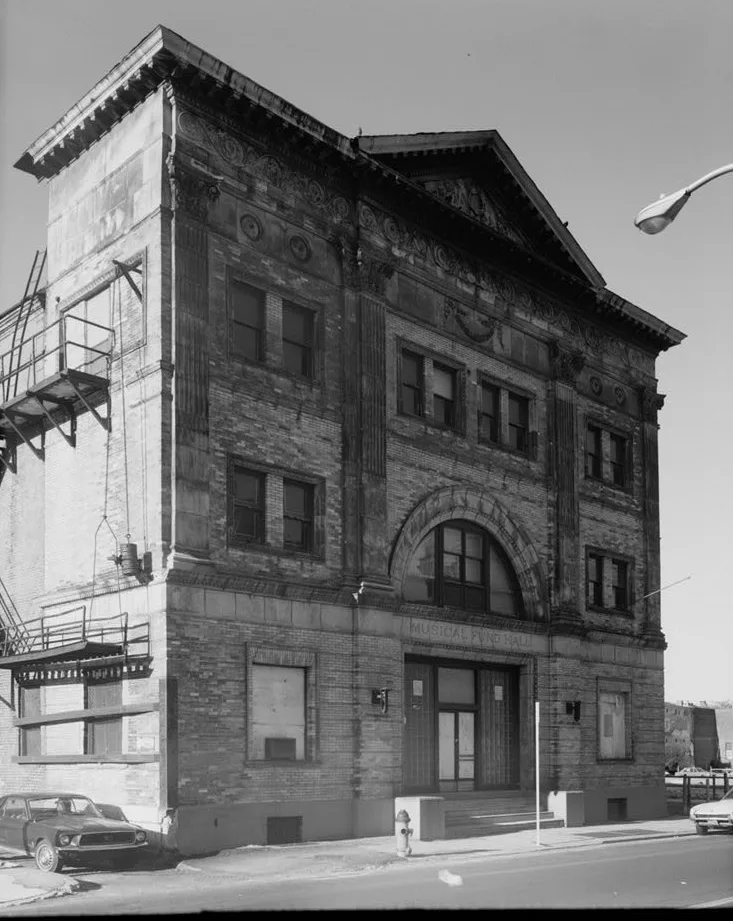

Why it's listed
Built in Philadelphia's Locust Street district for the Musical Fund Society, the hall opened to the public on December 24, 1824, to a design by William Strickland. Contemporary accounts describe its plain, simple exterior, and its interior was later reworked, with a remodeling by Nicholas LeBrun in 1847 that moved the street facade forward 16 feet and relocated the stage, and a further remodeling by Addison Hutton in 1891 that added a story and changed the windows and entrance. The hall seated 1500 and was celebrated for its acoustics. The Musical Fund Society, devoted to aiding musicians and improving public taste in music, met there for decades. In 1856 the hall hosted the first national Republican Convention, where the party organized nationally for the first time. The building is regarded as the oldest surviving music hall in the United States, and its political and musical associations form the basis of its listing.
Significance in brief: The nomination argues the hall is significant politically because the first national Republican Convention met there in 1856, which helped consolidate the party into a national organization. It is also significant musically as the home of the Musical Fund Society from 1824 into the 20th century, an influential organization for music in America. The hall is regarded as the oldest extant music hall in the United States and is noted for its acoustics.
Machine-generated summary. This summary was generated by a language model from the official nomination document and has not been reviewed line by line by an editor. It may contain errors. Check the source document before relying on any detail. Source: nomination document (PDF) · National Archives catalog entry. NRHP reference 71000730, listed March 11, 1971. Summary generated October 2026 (model claude-haiku-5-5, prompt v1.1-2026-10-29, confidence medium).
Key facts
| Address | 808 Locust St., Philadelphia |
|---|---|
| County | Philadelphia |
| Listed | March 11, 1971 |
| Reference number | 71000730 |
| Resource type | Building |
| Period of significance | 1824-1899 |
| Architect / builder | William Strickland (architect); Nicholas LeBrun (1847 remodeling); Addison Hutton (1891 remodeling) |
| Criteria |
|
| Areas of significance | Politics/Government, Performing Arts |
| Level of significance | National |
| National Historic Landmark | Yes, designated May 30, 1974 |
| Status (as stated in the nomination) | The building was used for many years as a warehouse and office for a cigar manufacturer and was converted to commercial use after 1891; the form states it is in excellent structural condition. |
| Acreage | 0.9 |
| Within district | Washington Square West Historic District |
| Coordinates | 39.94679, -75.15517 (NPS GIS) |
What listing means for this property
National Register listing is honorary for a privately owned home: it does not by itself restrict what an owner may do with their own money, and it does not require public access. Restrictions come from local landmark or historic-district ordinances, which are separate (how they differ).
Owner-occupied houses are not eligible for the 20% federal rehabilitation tax credit, which applies to income-producing buildings, but many states offer credits for homeowners. Listing also opens the door to preservation easements and to buying a plaque. Start with what listing means for homeowners, renovating a listed house and selling one.
General information, not legal or tax advice. Rules change; confirm with your State Historic Preservation Office or a qualified adviser.
Sources and further reading
- National Park Service, National Register of Historic Places database (snapshot May 2026), reference 71000730.
- Nomination form (PDF, National Archives) — catalog entry
- Wikipedia article (used for cross-checking only; text not reproduced here)
- Wikidata Q6942505
- This listing as JSON
Last updated October 2026. Found an error? See the editorial policy for how to report it.