Barret House

Why it's listed
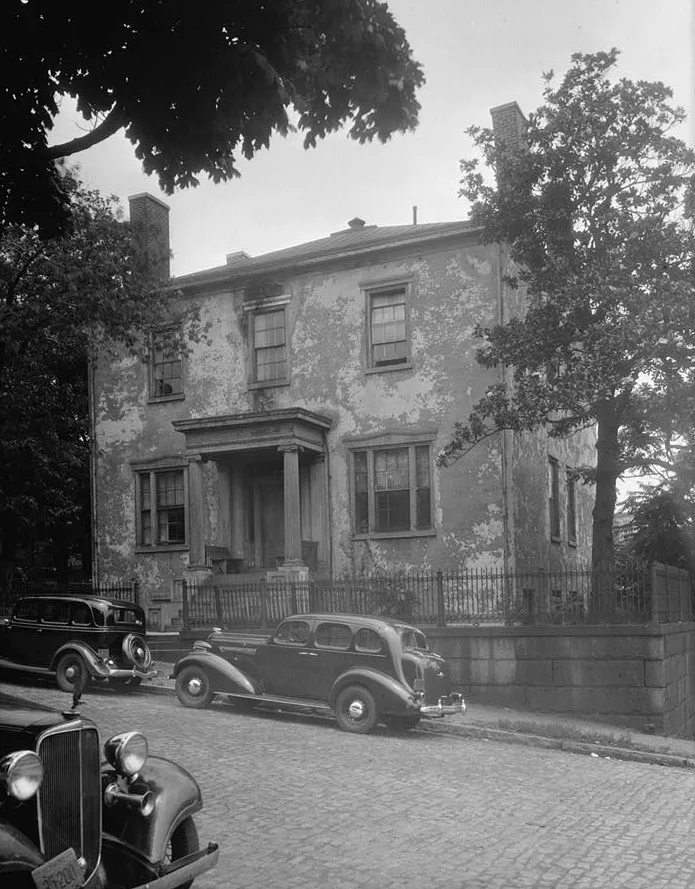
Built in 1844 at 15 South Fifth Street in Richmond, this grey stuccoed Greek Revival house has two stories above a basement. Tobacconist William Barrett, reportedly the original maker of "Lucky Strike" chewing tobacco, had it built, with his cousin Anderson Barrett, a builder, supervising the work. Its Ionic-columned entrance portico and triple first-floor windows reflect the later Greek Revival taste for ornament, while the overall proportions remain simple and symmetrical. Inside are a wide central hall, marble fireplaces, original woodwork and a gently spiralled mahogany stair. A stuccoed brick outbuilding once held servants' quarters above stables. Later occupants included a French consul and a Baptist mission leader. A planned demolition for a garage was avoided, and the house was restored in 1937 and later converted to offices. It is regarded as the finest of four Greek Revival houses built on Fifth Street in the 1840s.
Significance in brief: The nomination presents it as the best of four Greek Revival houses built on Fifth Street in the 1840s, thanks to the quality of its interior and exterior proportions. Fifth Street was the first of Richmond's riverside neighborhoods to be developed and was favored by prominent citizens from 1790 to 1880. Its adaptation to business use is credited with securing its future.
Machine-generated summary. This summary was generated by a language model from the official nomination document and has not been reviewed line by line by an editor. It may contain errors. Check the source document before relying on any detail. Source: nomination document (PDF) · National Archives catalog entry. NRHP reference 72001517, listed February 23, 1972. Summary generated October 2026 (model claude-sonnet-5-5, prompt v1.0-2026-10-29, confidence medium).
Key facts
| Address | 15 S. 5th St., Richmond (Independent City) |
|---|---|
| County | Richmond (city and county) |
| Listed | February 23, 1972 |
| Reference number | 72001517 |
| Resource type | Building |
| Period of significance | 19th Century (specific date 1844) |
| Architect / builder | Built under the supervision of Anderson Barrett, a builder and cousin of owner William Barrett |
| Architectural style | Greek Revival |
| Areas of significance | Commerce, Architecture |
| Level of significance | State |
| Status (as stated in the nomination) | Described as in good condition, restored in 1937 and in office use (Fitzgerald and Co.) at the time of nomination. |
| Acreage | 9.9 |
| Within district | James River and Kanawha Canal Historic District |
| Coordinates | 37.53975, -77.44038 (NPS GIS) |
What listing means for this property
National Register listing is honorary for a privately owned home: it does not by itself restrict what an owner may do with their own money, and it does not require public access. Restrictions come from local landmark or historic-district ordinances, which are separate (how they differ).
Owner-occupied houses are not eligible for the 20% federal rehabilitation tax credit, which applies to income-producing buildings, but many states offer credits for homeowners. Listing also opens the door to preservation easements and to buying a plaque. Start with what listing means for homeowners, renovating a listed house and selling one.
General information, not legal or tax advice. Rules change; confirm with your State Historic Preservation Office or a qualified adviser.
Sources and further reading
- National Park Service, National Register of Historic Places database (snapshot May 2026), reference 72001517.
- Nomination form (PDF, National Archives) — catalog entry
- Wikipedia article (used for cross-checking only; text not reproduced here)
- Wikidata Q4863396
- This listing as JSON
Last updated October 2026. Found an error? See the editorial policy for how to report it.