Firstside Historic District
Also known as: Monongahela Wharf

Why it's listed
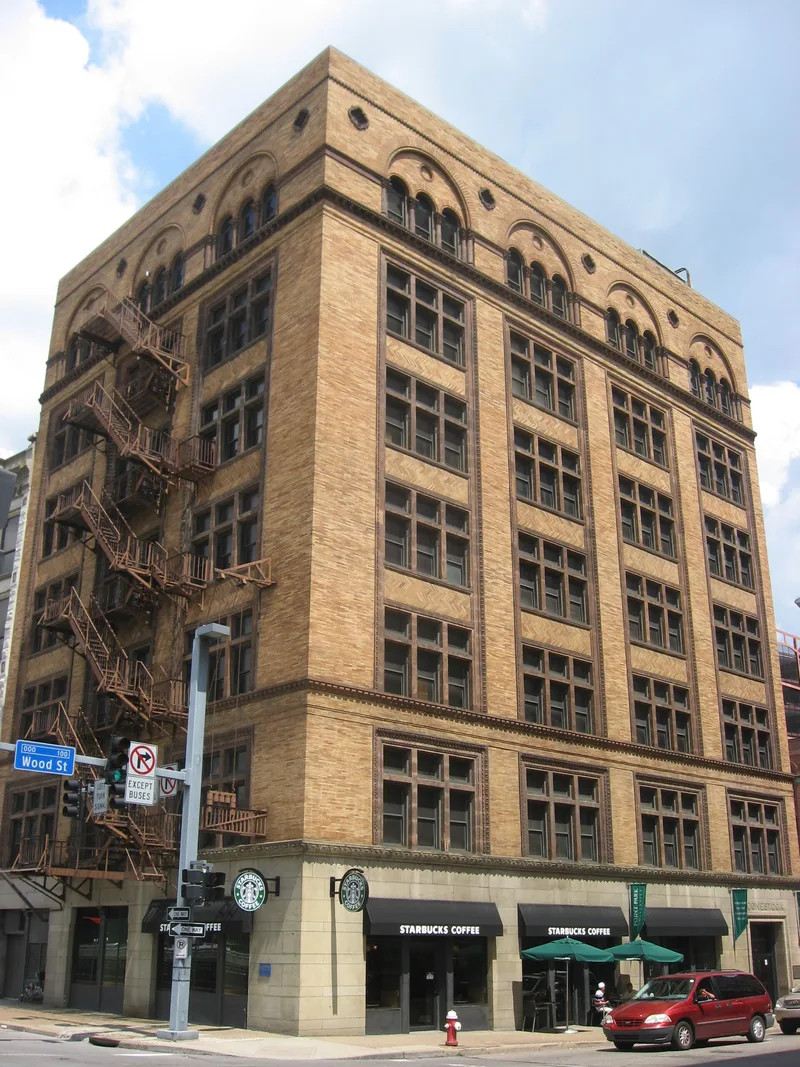
Along the north bank of the Monongahela River in downtown Pittsburgh, a row of twelve mostly three- to five-story brick warehouses was built between 1845 and 1914 to serve the Monongahela Wharf, the city's main commercial waterfront. Reconstruction after a fire in 1845 produced many of the early buildings, and their facades stand in one plane. The styles range from Greek Revival at 211 Fort Pitt Boulevard to Italianate at 213-233, Queen Anne at 239-249, and Richardsonian Romanesque at 243-245 and the seven-story Conestoga Building at 1-7 Wood Street, designed by Longfellow, Alden & Harlow and built in 1892 by G. A. Cochran. The buildings housed commission merchants, manufacturers and wholesalers who depended on steamboat freight. Their warehouse architecture is considered intact and representative of mid-nineteenth to early twentieth century Pittsburgh. Two later-altered buildings are excluded from the historic count. The district was listed for its commercial role on the river and for this architectural record.
Significance in brief: The district is argued to be commercially significant for its role in Pittsburgh's river trade, since the Monongahela Wharf was the city's principal commercial wharf from the 1840s through the 1930s. It is also architecturally significant as an intact, representative collection of mid-nineteenth to early twentieth century warehouse architecture in downtown Pittsburgh, including Greek Revival, Italianate, Queen Anne and Richardsonian Romanesque examples.
Machine-generated summary. This summary was generated by a language model from the official nomination document and has not been reviewed line by line by an editor. It may contain errors. Check the source document before relying on any detail. Source: nomination document (PDF) · National Archives catalog entry. NRHP reference 88001215, listed July 28, 1988. Summary generated October 2026 (model claude-haiku-5-5, prompt v1.1-2026-10-29, confidence high).
Key facts
| Address | 211--249 Fort Pitt Blvd.; 1--7 Wood St., Pittsburgh |
|---|---|
| County | Allegheny County |
| Listed | July 28, 1988 |
| Reference number | 88001215 |
| Resource type | District |
| Period of significance | 1845 - 1938 |
| Architect / builder | 1-7 Wood Street: Longfellow, Alden & Harlow (architects); G. A. Cochran (builder) |
| Architectural style | Greek Revival, Italianate, Queen Anne, Richardsonian Romanesque |
| Criteria |
|
| Areas of significance | Commerce, Architecture |
| Level of significance | Local |
| Status (as stated in the nomination) | Most contributing buildings are described as relatively intact with some storefront alterations and window replacements; two buildings are non-contributing; restoration of 243-245 Fort Pitt Boulevard was underway at the time of the form. |
| Acreage | 1.6 |
| Coordinates | 40.43826, -80.00278 (NPS GIS) |
What listing means for this property
This is a historic district. Buildings within its boundary are either contributing (they add to the district's significance) or non-contributing. Owners of contributing income-producing buildings can claim the 20% federal rehabilitation tax credit; homeowners should look at state credits. National Register districts impose no design review by themselves; a local historic district ordinance, if one exists, does (the difference explained).
General information, not legal or tax advice. Rules change; confirm with your State Historic Preservation Office or a qualified adviser.
Sources and further reading
- National Park Service, National Register of Historic Places database (snapshot May 2026), reference 88001215.
- Nomination form (PDF, National Archives) — catalog entry
- Wikipedia article (used for cross-checking only; text not reproduced here)
- Wikidata Q5454286
- This listing as JSON
Last updated October 2026. Found an error? See the editorial policy for how to report it.