Smithfield Street Bridge

Why it's listed
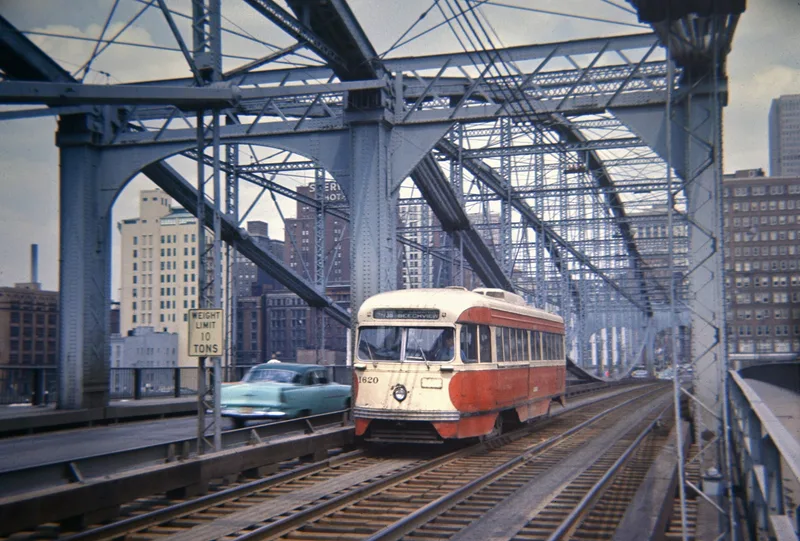
Smithfield Street crosses the Monongahela River in Pittsburgh on a double lenticular, or Pauli, truss bridge completed in 1883. Designed by Gustave Lindenthal, one of the best-known bridge engineers of his time, it replaced an earlier suspension bridge designed by John A. Roebling, which had itself succeeded a span from 1818 that burned in 1845. The original single lane was twenty feet wide, and a second lane of the same width was added on the upstream side in 1889, with the truss widened in 1911. Six curved steel trusses rest on rusticated stone piers. The entrance arches were built in a Norman Romanesque style, with basket-handle arches, corbeled imposts, and a crenelated cornice, and they use steel and iron rather than masonry. The bridge is regarded as an early example of steel's use in bridge engineering and as one of the most important lenticular truss spans in the country.
Significance in brief: The nomination argues the bridge is an early and creative use of steel in bridge design and a graceful example of the double lenticular truss. Its Romanesque-style entrance arches, built of steel and iron, are presented as a notable expression of late Victorian engineering. It is described as an early statement of American industrial growth and as incorporating the largest lenticular trusses in the country.
Machine-generated summary. This summary was generated by a language model from the official nomination document and has not been reviewed line by line by an editor. It may contain errors. Check the source document before relying on any detail. Source: nomination document (PDF) · National Archives catalog entry. NRHP reference 74001745, listed March 21, 1974. Summary generated October 2026 (model claude-haiku-5-5, prompt v1.1-2026-10-29, confidence medium).
Key facts
| Address | Smithfield St. at the Monongahela River, Pittsburgh |
|---|---|
| County | Allegheny County |
| Listed | March 21, 1974 |
| Reference number | 74001745 |
| Resource type | Structure |
| Period of significance | 1883-1889 |
| Architect / builder | Gustave Lindenthal (designer) |
| Architectural style | Norman Romanesque entrance arches; lenticular truss |
| Criteria |
|
| Areas of significance | Engineering |
| Level of significance | National |
| National Historic Landmark | Yes, designated May 11, 1976 |
| Status (as stated in the nomination) | The bridge remains in very good condition according to the description, though the condition checkbox marked fair. |
| Acreage | 1 |
| Coordinates | 40.43485, -80.00215 (NPS GIS) |
What listing means for this property
For a publicly owned building or structure, listing mainly matters when federal funds, permits or licences are involved: projects then go through Section 106 review so effects on the property are considered. Listing also strengthens applications for preservation grants and, for leased income-producing uses, can enable the federal rehabilitation tax credit.
General information, not legal or tax advice. Rules change; confirm with your State Historic Preservation Office or a qualified adviser.
Sources and further reading
- National Park Service, National Register of Historic Places database (snapshot May 2026), reference 74001745.
- Nomination form (PDF, National Archives) — catalog entry
- Wikipedia article (used for cross-checking only; text not reproduced here)
- Wikidata Q7545513
- This listing as JSON
Last updated October 2026. Found an error? See the editorial policy for how to report it.