Lafayette Park Historic
Also known as: See Also:71000520; 71000519; 71000521; 71000515; 72000812; 740001

Why it's listed
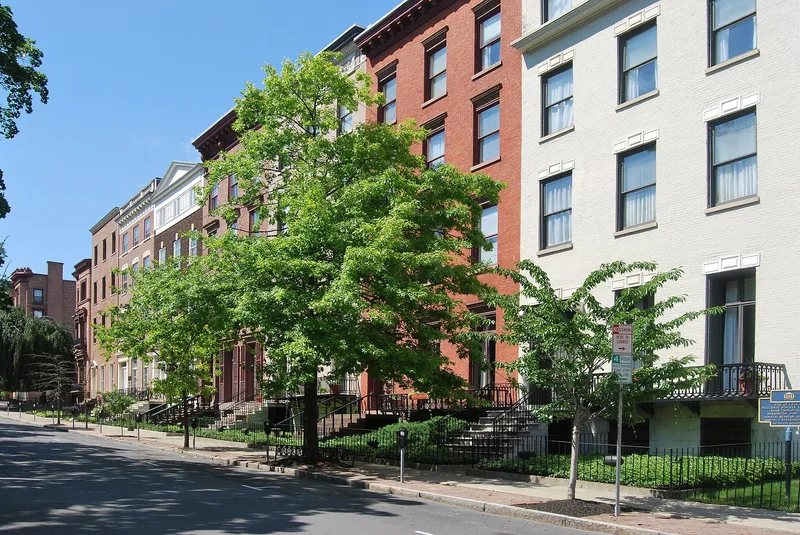
Lafayette Park Historic District occupies the crest of Capitol Hill in Albany, where state and city government buildings face a landscaped park. Five individually listed landmarks sit within it, including the State Capitol, City Hall, the Court of Appeals, the Education Building, and the Cathedral of All Saints. Along the park's northern edge, twenty-nine brick rowhouses on Elk and Columbia Streets provide a domestic counterpoint to the monumental civic architecture. Their closeness to the seats of power attracted governors, a bishop, bankers, lumber merchants, and physicians, and the houses show a wide range of tastes, from Greek Revival to Gothic Revival details. Martin Van Buren's family owned property here, and several houses served as governors' residences. Later uses include law offices, a restaurant, and apartments, and three modern buildings are counted as intrusions. Remnants of the 1890 Hawk Street Viaduct, an innovative cantilever arch bridge, also survive within the boundaries.
Significance in brief: The district combines monumental civic architecture with a residential enclave that gives the civic center a domestic scale. Its closeness to the courthouses, City Hall and Capitol drew governors, bishops, bankers, and industrialists to live there. The Hawk Street Viaduct remnants also add engineering significance.
Machine-generated summary. This summary was generated by a language model from the official nomination document and has not been reviewed line by line by an editor. It may contain errors. Check the source document before relying on any detail. Source: nomination document (PDF) · National Archives catalog entry. NRHP reference 78001837, listed November 15, 1978. Summary generated October 2026 (model claude-sonnet-5-5, prompt v1.0-2026-10-29, confidence medium).
Key facts
| Address | Roughly bounded by State, Swan, Elk, Spruce, Chapel and Eagle Sts., Albany |
|---|---|
| County | Albany County |
| Listed | November 15, 1978 |
| Reference number | 78001837 |
| Resource type | District |
| Period of significance | 1800-1899, 1900- |
| Architect / builder | H.H. Richardson (City Hall, Capitol); Philip Hooker (Albany Academy); Henry Hornbostel (Education Building); Hoppin and Koen (County Courthouse); Robert Gibson (Cathedral); James Polshek (Bar Association complex); Elnathan Sweet (Hawk St. Viaduct) |
| Architectural style | Nineteenth-century brick rowhouses (Greek Revival, Gothic Revival) with Neoclassical civic buildings |
| Areas of significance | Politics/Government, Architecture |
| Level of significance | State, Local |
| Status (as stated in the nomination) | Condition marked deteriorated and good. Most Columbia Street houses are law offices, Elk Street houses have civic and commercial uses, and upper floors are often apartments. Nos. 83 and 85 Columbia Street were fire-damaged and empty. |
| Acreage | 36 |
| Coordinates | 42.65319, -73.75596 (NPS GIS) |
What listing means for this property
This is a historic district. Buildings within its boundary are either contributing (they add to the district's significance) or non-contributing. Owners of contributing income-producing buildings can claim the 20% federal rehabilitation tax credit; homeowners should look at state credits. National Register districts impose no design review by themselves; a local historic district ordinance, if one exists, does (the difference explained).
General information, not legal or tax advice. Rules change; confirm with your State Historic Preservation Office or a qualified adviser.
Sources and further reading
- National Park Service, National Register of Historic Places database (snapshot May 2026), reference 78001837.
- Nomination form (PDF, National Archives) — catalog entry
- Wikipedia article (used for cross-checking only; text not reproduced here)
- Wikidata Q6471490
- This listing as JSON
Last updated October 2026. Found an error? See the editorial policy for how to report it.