Lafayette Park Historic

Why it's listed
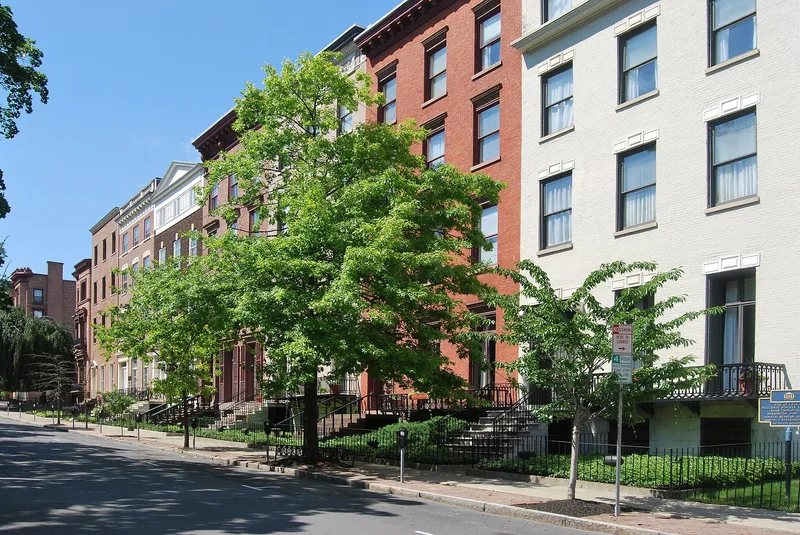
Lafayette Park Historic District occupies the crest of Capitol Hill in Albany, where state and city government buildings face a landscaped park. Five individually listed landmarks sit within it, including the State Capitol, City Hall, the Court of Appeals, the Education Building, and the Cathedral of All Saints. Along the park's northern edge, twenty-nine brick rowhouses on Elk and Columbia Streets provide a domestic counterpoint to the monumental civic architecture. Their closeness to the seats of power attracted governors, a bishop, bankers, lumber merchants, and physicians, and the houses show a wide range of tastes, from Greek Revival to Gothic Revival details. Martin Van Buren's family owned property here, and several houses served as governors' residences. Later uses include law offices, a restaurant, and apartments, and three modern buildings are counted as intrusions. Remnants of the 1890 Hawk Street Viaduct, an innovative cantilever arch bridge, also survive within the boundaries.
Machine-generated summary. This summary was generated by a language model from the official nomination document and has not been reviewed line by line by an editor. It may contain errors. Check the source document before relying on any detail. Source: nomination document (PDF) · catalog entry. Generated October 2026 (model claude-sonnet-5-5, prompt v1.0-2026-10-29).
| Period of significance | 1800-1899, 1900- |
|---|---|
| Styles | Nineteenth-century brick rowhouses (Greek Revival, Gothic Revival) with Neoclassical civic buildings |
| Areas of significance | Politics/Government, Architecture |
| Acreage | 36 |
| Boundary source | NPS cultural-resource GIS polygon |
| Full listing page | Lafayette Park Historic (property record) |
What listing means for this property
This is a historic district. Buildings within its boundary are either contributing (they add to the district's significance) or non-contributing. Owners of contributing income-producing buildings can claim the 20% federal rehabilitation tax credit; homeowners should look at state credits. National Register districts impose no design review by themselves; a local historic district ordinance, if one exists, does (the difference explained).
General information, not legal or tax advice. Rules change; confirm with your State Historic Preservation Office or a qualified adviser.