Back Bay Historic District

Why it's listed
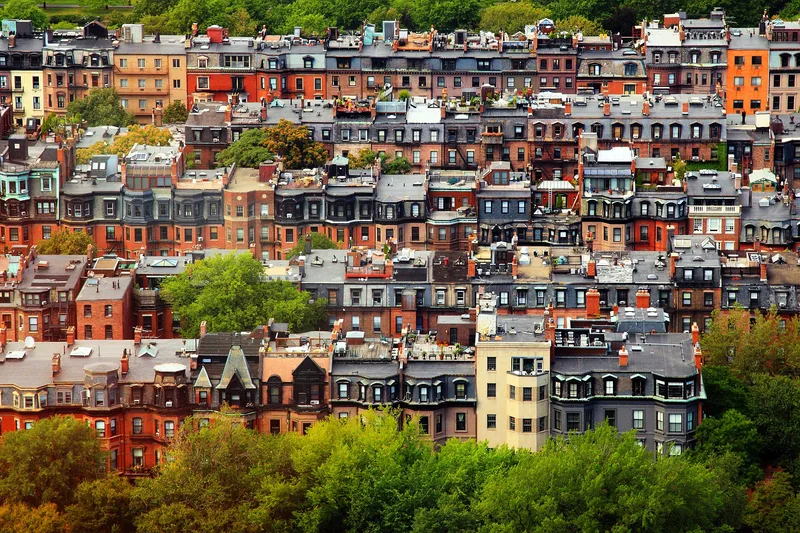
Back Bay is a densely built Boston neighborhood of townhouses, apartments, churches, schools and businesses, laid out on about 450 acres of reclaimed tidal flats. Filling began in 1857 near Arlington Street and continued west until the late 1880s. Arthur Gilman's plan, influenced by French urban design, arranged a grid of streets around Commonwealth Avenue, a wide boulevard with a central mall. Setback rules, height limits and masonry requirements produced uniform block fronts despite a wide range of styles, from Italianate to Richardsonian Romanesque and Beaux Arts. Copley Square holds landmarks such as Trinity Church and the Boston Public Library. The district was also home to leading writers, artists and institutions of nineteenth-century Boston. Later amendments recognize an archaeological fishweir thousands of years old beneath the neighborhood and early twentieth-century commercial buildings along Boylston and Newbury Streets. Much of the original character survives, and the residential area has been protected as a conservation district since 1966.
Machine-generated summary. This summary was generated by a language model from the official nomination document and has not been reviewed line by line by an editor. It may contain errors. Check the source document before relying on any detail. Source: nomination document (PDF) · catalog entry. Generated October 2026 (model claude-sonnet-5-5, prompt v1.0-2026-10-29).
| Styles | Wide variety: Italianate, French Academic, Gothic, Ruskinian Gothic, Queen Anne, Richardsonian Romanesque, and later Revival styles, Beaux Arts and Commercial |
|---|---|
| Areas of significance | Prehistoric, Community Planning and Development, Landscape Architecture, Art, Engineering, Architecture, Religion, Social History |
| Acreage | 340 |
| Boundary source | NPS cultural-resource GIS polygon |
| Full listing page | Back Bay Historic District (property record) |
What listing means for this property
This is a historic district. Buildings within its boundary are either contributing (they add to the district's significance) or non-contributing. Owners of contributing income-producing buildings can claim the 20% federal rehabilitation tax credit; homeowners should look at state credits. National Register districts impose no design review by themselves; a local historic district ordinance, if one exists, does (the difference explained).
General information, not legal or tax advice. Rules change; confirm with your State Historic Preservation Office or a qualified adviser.