Alamo, The

Why it's listed
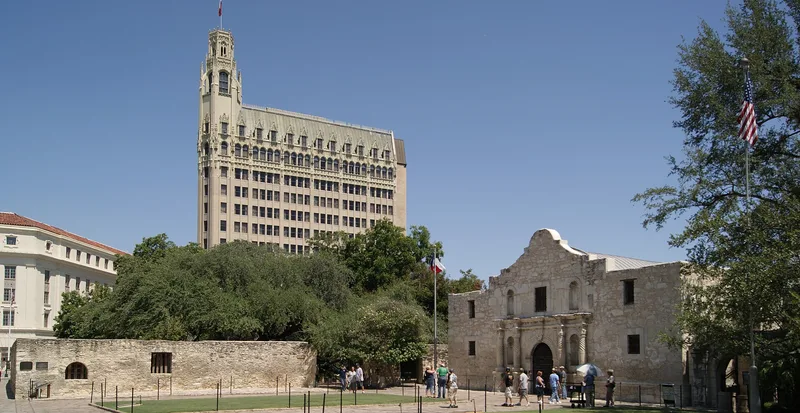
The Alamo is the former mission church of San Antonio de Valero, built of stone between 1744 and 1757 on Alamo Plaza in San Antonio. Franciscan friars founded the mission in 1718, and it was moved to its present site in 1724. The church lost its towers, vaulting and dome in 1762 and was never fully repaired. Its facade has paired columns, niches and Spanish-style interlaced ornament. After the mission was abandoned in 1793, Spanish and Mexican troops used it, and the name Alamo probably came from a Spanish military company. In 1836 about 187 Texan defenders, among them James Bowie and David Crockett, held it against a far larger Mexican force, and all were killed on March 6. Their stand won American sympathy for the Texan cause. Later the United States Army, a grocery firm and the State of Texas used parts of the site. Today the chapel, restored ruins of two living quarters and part of the original wall remain, within a landscaped park that includes a museum.
Significance in brief: The chapel was the site of the 1836 battle in the Texan War for Independence, in which about 187 defenders, including James Bowie and David Crockett, were killed. Their deaths won sympathy in the United States for the Texan cause and strengthened the will to throw off Mexican rule. The building also preserves Spanish mission architecture and a long record of military, church and state use.
Machine-generated summary. This summary was generated by a language model from the official nomination document and has not been reviewed line by line by an editor. It may contain errors. Check the source document before relying on any detail. Source: nomination document (PDF) · National Archives catalog entry. NRHP reference 66000808, listed October 15, 1966. Summary generated October 2026 (model claude-sonnet-5-5, prompt v1.0-2026-10-29, confidence high).
Key facts
| Address | Alamo Plaza, San Antonio |
|---|---|
| County | Bexar County |
| Listed | October 15, 1966 |
| Reference number | 66000808 |
| Resource type | Building |
| Period of significance | 1700-1799, 1800-1899 (specific dates 1744, 1836) |
| Architectural style | Spanish mission church with Spanish-derived interlace ornament |
| Areas of significance | Military |
| Level of significance | National |
| National Historic Landmark | Yes, designated December 19, 1960 |
| Status (as stated in the nomination) | State-owned and administered by the Daughters of the Republic of Texas; occupied and used as a museum. Only the chapel, the restored ruins of two living quarters and a section of original wall remain of the mission compound. |
| Acreage | 5 |
| Within district | Alamo Plaza Historic District |
| Coordinates | 29.42536, -98.48607 (NPS GIS) |
What listing means for this property
National Register listing is honorary: it recognises significance and does not restrict what a private owner may do without federal money or permits. It unlocks the 20% federal rehabilitation tax credit for income-producing buildings, state credits in many states, and Section 106 review when federal agencies are involved. See what listing means in practice.
General information, not legal or tax advice. Rules change; confirm with your State Historic Preservation Office or a qualified adviser.
Sources and further reading
- National Park Service, National Register of Historic Places database (snapshot May 2026), reference 66000808.
- Nomination form (PDF, National Archives) — catalog entry
- Wikipedia article (used for cross-checking only; text not reproduced here)
- Wikidata Q2636724
- This listing as JSON
Last updated October 2026. Found an error? See the editorial policy for how to report it.