Leidy, Dr. Joseph, House
Also known as: Poor Richard Club

Why it's listed
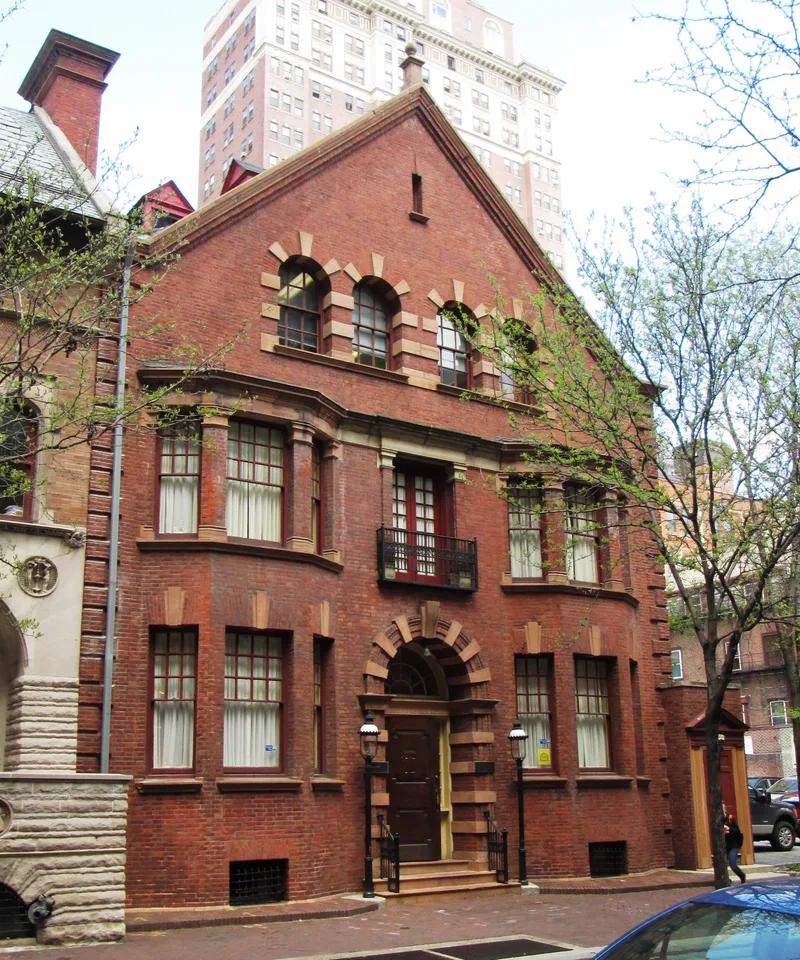
Built on Locust Street in Philadelphia in 1893 to a design by Wilson Eyre, Jr., this red brick townhouse with brownstone trim was commissioned by Dr. Joseph Leidy, Jr., nephew of the naturalist Joseph Leidy, who used it as a medical practice and family home for about three decades. Eyre chose the Georgian idiom, with symmetrical facade, quoins, and rusticated brownstone around the arched doorway, making it one of the earliest urban colonial revival houses in the city. Its restrained composition differs from the Venetian Revival neighboring house Eyre designed for Clarence Moore. The house was remodeled in 1925 by G. Edwin Brumbaugh when the Poor Richard Club, an advertising and public relations fraternity, acquired it. The club sponsored the Charles Morris Price School of Advertising and Journalism. The original oval dining room survives largely intact.
Significance in brief: The nomination argues the house is an early and important example of the colonial revival in an urban setting by a major Philadelphia architect. It is described as Eyre's highest expression of urban design alongside the neighboring Clarence Moore house. The building is also tied to the Poor Richard Club and its Charles Morris Price School of Advertising and Journalism.
Machine-generated summary. This summary was generated by a language model from the official nomination document and has not been reviewed line by line by an editor. It may contain errors. Check the source document before relying on any detail. Source: nomination document (PDF) · National Archives catalog entry. NRHP reference 80003613, listed December 4, 1980. Summary generated October 2026 (model claude-haiku-5-5, prompt v1.1-2026-10-29, confidence medium).
Key facts
| Address | 1319 Locust St., Philadelphia |
|---|---|
| County | Philadelphia |
| Listed | December 4, 1980 |
| Reference number | 80003613 |
| Resource type | Building |
| Period of significance | 1893-1930 |
| Architect / builder | Wilson Eyre, Jr. (architect); G. Edwin Brumbaugh (1925 alterations) |
| Architectural style | Colonial Revival |
| Criteria |
|
| Areas of significance | Commerce, Education, Architecture, Social History |
| Level of significance | National |
| Status (as stated in the nomination) | Occupied by the Poor Richard Club and later by District 1199C, which planned to use the Club facilities for meetings and cultural events. |
| Acreage | 0.1 |
| Coordinates | 39.94794, -75.16351 (NPS GIS) |
What listing means for this property
National Register listing is honorary for a privately owned home: it does not by itself restrict what an owner may do with their own money, and it does not require public access. Restrictions come from local landmark or historic-district ordinances, which are separate (how they differ).
Owner-occupied houses are not eligible for the 20% federal rehabilitation tax credit, which applies to income-producing buildings, but many states offer credits for homeowners. Listing also opens the door to preservation easements and to buying a plaque. Start with what listing means for homeowners, renovating a listed house and selling one.
General information, not legal or tax advice. Rules change; confirm with your State Historic Preservation Office or a qualified adviser.
Sources and further reading
- National Park Service, National Register of Historic Places database (snapshot May 2026), reference 80003613.
- Nomination form (PDF, National Archives) — catalog entry
- Wikipedia article (used for cross-checking only; text not reproduced here)
- Wikidata Q5304215
- This listing as JSON
Last updated October 2026. Found an error? See the editorial policy for how to report it.