New Century Guild

Why it's listed
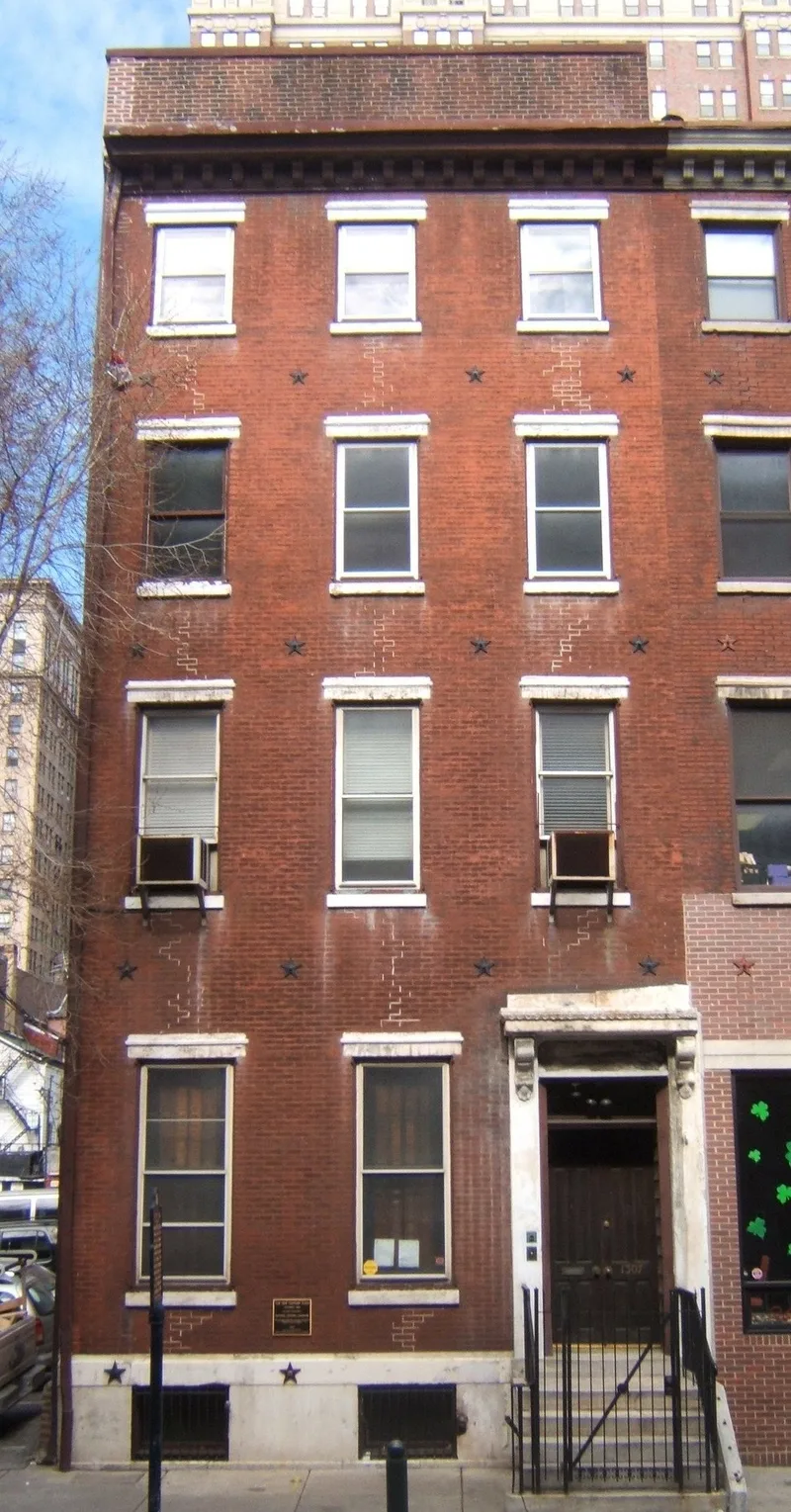
Four stories on a raised basement, the brick rowhouse at 1307 Locust Street in Philadelphia was occupied by the New Century Guild in 1906 and has remained its home since. The facade has marble lintels and sills, and the interior retains late Victorian and Edwardian woodwork, including a library with Chippendale revival cabinets, an auditorium with a spindle-work valance and a fourth-floor billiard room. The Guild was founded in 1882 by Eliza Turner and grew to about 1,000 members by 1906. It offered working women a restaurant serving noonday meals, a large library with a full-time librarian, evening classes, guest rooms, a health insurance plan and a working women's newspaper founded in 1887. Its research section collected statistics on women workers and fed proposals for protective labor legislation. The building is significant for the social history of women's organizing and for its survival with a high degree of integrity from that period.
Significance in brief: The nomination argues the Guild was one of the earliest, largest and most successful organizations formed in the nineteenth century to address employment problems of working women. It offered a combination of services, including a newspaper, research section, library, restaurant, classes and health insurance, that few comparable groups provided. The building is described as the only one of its kind still intact.
Machine-generated summary. This summary was generated by a language model from the official nomination document and has not been reviewed line by line by an editor. It may contain errors. Check the source document before relying on any detail. Source: nomination document (PDF) · National Archives catalog entry. NRHP reference 93001611, listed November 4, 1993. Summary generated October 2026 (model claude-haiku-5-5, prompt v1.1-2026-10-29, confidence high).
Key facts
| Address | 1307 Locust St., Philadelphia |
|---|---|
| County | Philadelphia |
| Listed | November 4, 1993 |
| Reference number | 93001611 |
| Resource type | Building |
| Period of significance | 1906-1943 |
| Architect / builder | Bunting and Shrigley (alterations for NCG) |
| Architectural style | Mid-19th Century Italianate |
| Criteria |
|
| Areas of significance | Social History |
| Level of significance | National |
| National Historic Landmark | Yes, designated November 4, 1993 |
| Status (as stated in the nomination) | The building has served as the Guild's location continuously from 1906 to the present. |
| Acreage | 0.9 |
| Coordinates | 39.94822, -75.16267 (NPS GIS) |
What listing means for this property
National Register listing is honorary: it recognises significance and does not restrict what a private owner may do without federal money or permits. It unlocks the 20% federal rehabilitation tax credit for income-producing buildings, state credits in many states, and Section 106 review when federal agencies are involved. See what listing means in practice.
General information, not legal or tax advice. Rules change; confirm with your State Historic Preservation Office or a qualified adviser.
Sources and further reading
- National Park Service, National Register of Historic Places database (snapshot May 2026), reference 93001611.
- Nomination form (PDF, National Archives) — catalog entry
- Wikipedia article (used for cross-checking only; text not reproduced here)
- Wikidata Q9049714
- This listing as JSON
Last updated October 2026. Found an error? See the editorial policy for how to report it.