Grove Place Historic District

Why it's listed
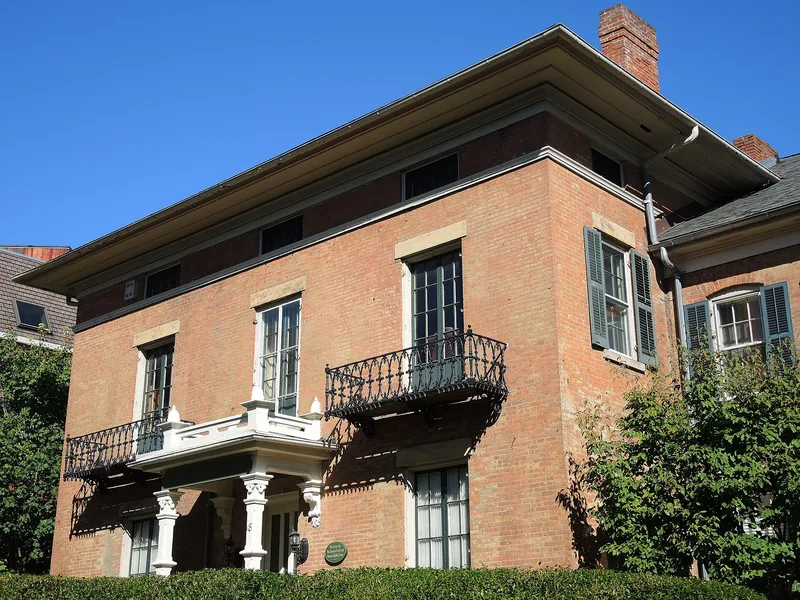
Grove Place is a compact residential district of twenty-two buildings in eastern downtown Rochester, set among Gibbs, Selden, Windsor and Grove streets. It preserves part of "The Grove," the homestead area settled in the 1840s by the Ward and Selden families, who intermarried and lived there for more than a century. George B. Selden developed his internal combustion engine, patented in 1870, in a workshop behind the Selden Street buildings, though that workshop no longer exists. The original homestead was demolished in 1914 for the YMCA. Surviving buildings, mostly two- and three-story homes built between about 1845 and the 1890s, show Italianate, Queen Anne, Eastlake and Greek Revival influences. The standout is a row of six Gothic-Tudor Revival townhouses at 128-152 Gibbs Street, built in 1878 for Theodore Bacon, which was unusual for upstate New York and for a city of mainly detached houses. Consistent size and setbacks give the area a neighborhood feel amid commercial surroundings.
Significance in brief: The district is argued to be significant architecturally and historically as an intact enclave of small-scale nineteenth-century homes built, owned and occupied for over 100 years by the extended Ward and Selden families. It preserves about sixty percent of the original homestead area known as "The Grove." It is the only nineteenth-century residential area surviving in the multiple resource area.
Machine-generated summary. This summary was generated by a language model from the official nomination document and has not been reviewed line by line by an editor. It may contain errors. Check the source document before relying on any detail. Source: nomination document (PDF) · National Archives catalog entry. NRHP reference 84000299, listed October 11, 1984. Summary generated October 2026 (model claude-sonnet-5-5, prompt v1.0-2026-10-29, confidence high).
Key facts
| Address | Gibbs, Selden, Grove and Windsor Sts., Rochester |
|---|---|
| County | Monroe County |
| Listed | October 11, 1984 |
| Reference number | 84000299 |
| Resource type | District |
| Period of significance | 1850-1895 |
| Architectural style | Italianate, Gothic-Tudor Revival, Queen Anne, Eastlake, transitional Greek Revival |
| Areas of significance | Architecture, Social History |
| Level of significance | Local |
| Status (as stated in the nomination) | Most buildings are well maintained, and several were being rehabilitated or restored. Parking lots lie within the district but are screened and not obtrusive. |
| Acreage | 8.1 |
| Coordinates | 43.15996, -77.60068 (NPS GIS) |
What listing means for this property
This is a historic district. Buildings within its boundary are either contributing (they add to the district's significance) or non-contributing. Owners of contributing income-producing buildings can claim the 20% federal rehabilitation tax credit; homeowners should look at state credits. National Register districts impose no design review by themselves; a local historic district ordinance, if one exists, does (the difference explained).
General information, not legal or tax advice. Rules change; confirm with your State Historic Preservation Office or a qualified adviser.
Sources and further reading
- National Park Service, National Register of Historic Places database (snapshot May 2026), reference 84000299.
- Nomination form (PDF, National Archives) — catalog entry
- Wikipedia article (used for cross-checking only; text not reproduced here)
- Wikidata Q5611435
- This listing as JSON
Last updated October 2026. Found an error? See the editorial policy for how to report it.