Binghamton Theatre
Also known as: Capri Theatre; The Forum

Why it's listed
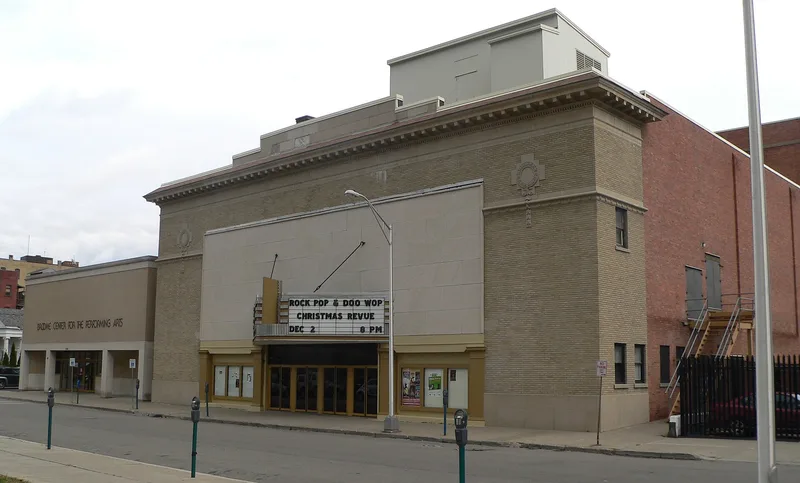
Built in 1919 at 236 Washington Street, the Binghamton Theatre was designed by Brooklyn architect Herbert Brewster as a showcase for vaudeville acts and silent films. Its austere Neoclassical exterior combines a yellow Roman brick facade with cast-stone bands, a deep modillion cornice and large cartouches. The interior is far more ornate, with a coffered ceiling, a painted sixteen-section dome, Corinthian columns, and classical moldings. The theater was updated with Vitaphone sound in 1927, closed in 1931, reopened as a movie house in 1946 with an Art Deco marquee, and was remodeled in 1960 as the Capri movie house, which removed the box seats and some columns. A 1981 wing now serves as the entrance and lobby. Since the 1970s the building has operated as a performing arts center, and a restored 1922 theater organ is in working order. It is significant as a typical, well-preserved example of a modest-sized theater of its period.
Significance in brief: The nomination argues it is a distinctive example of an early twentieth century theater in Binghamton. Its restrained Neoclassical exterior and lavishly ornamented interior survive largely intact despite alterations made for vaudeville, silent films, talkies, 1940s and 1960 movie-house uses, and later performing arts use. A rare restored 1922 theater organ adds to its interest.
Machine-generated summary. This summary was generated by a language model from the official nomination document and has not been reviewed line by line by an editor. It may contain errors. Check the source document before relying on any detail. Source: nomination document (PDF) · National Archives catalog entry. NRHP reference 07001451, listed January 23, 2008. Summary generated October 2026 (model claude-sonnet-5-5, prompt v1.0-2026-10-29, confidence high).
Key facts
| Address | 236 Washington St., Binghamton |
|---|---|
| County | Broome County |
| Listed | January 23, 2008 |
| Reference number | 07001451 |
| Resource type | Building |
| Period of significance | 1919-c1950 |
| Architect / builder | Herbert Brewster |
| Architectural style | Late 19th and early 20th century revivals (Neoclassical) |
| Criteria |
|
| Areas of significance | Architecture |
| Level of significance | Local |
| Status (as stated in the nomination) | Remains a venue for the performing arts in Binghamton; the theater organ is fully operational. |
| Acreage | 0.9 |
| Coordinates | 42.10386, -75.91195 (NPS GIS) |
What listing means for this property
For an income-producing building, listing (individually or as a contributing building in a district) is the gateway to the 20% federal rehabilitation tax credit on qualified rehabilitation costs, often stackable with state credits. Work claiming the credit must follow the Secretary of the Interior's Standards and be approved in advance.
Listing does not restrict a private owner acting without federal money or permits; where federal funding or licensing is involved, Section 106 review applies.
General information, not legal or tax advice. Rules change; confirm with your State Historic Preservation Office or a qualified adviser.
Sources and further reading
- National Park Service, National Register of Historic Places database (snapshot May 2026), reference 07001451.
- Nomination form (PDF, National Archives) — catalog entry
- Wikipedia article (used for cross-checking only; text not reproduced here)
- Wikidata Q4914251
- This listing as JSON
Last updated October 2026. Found an error? See the editorial policy for how to report it.