Binghamton Railway Company Complex

Why it's listed
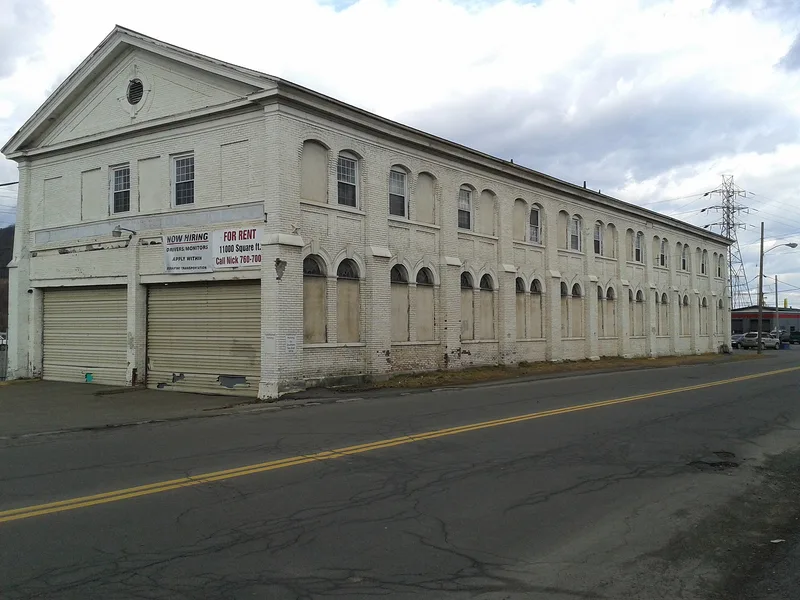
Located on State Street in northeast Binghamton, this group of attached brick and reinforced concrete buildings served the city's electric streetcars and later its buses. It combines half of an 1893 powerhouse, a large 1906 repair shop and office building with a nearby machine shop, a battery building, and infill added in the 1930s and 1940s. Inside, a traveling beam hoist for lifting streetcars and an iron catwalk survive. The nomination ranks it as the most intact complex in New York built to service a city streetcar system. The powerhouse was the first built specifically to supply Binghamton's trolley lines, and trade journals of the period praised both it and the later shops. After streetcars were replaced by buses in 1932, the buildings continued as bus maintenance and headquarters space into the 1980s. Some windows and doors have been replaced and a western section was lost, but most original openings and the floor plan remain. The complex was listed for its transportation history and its purpose-built design.
Significance in brief: The nomination argues the complex is significant for its long association with public transportation in Binghamton, from electric streetcars to buses. It includes part of the 1893 powerhouse, the city's first independent power source for electric streetcars, and the 1905-06 repair shops and offices. It is described as the largest and most intact streetcar service complex in New York State and as an example of early car house construction.
Machine-generated summary. This summary was generated by a language model from the official nomination document and has not been reviewed line by line by an editor. It may contain errors. Check the source document before relying on any detail. Source: nomination document (PDF) · National Archives catalog entry. NRHP reference 06001076, listed November 29, 2006. Summary generated October 2026 (model claude-sonnet-5-5, prompt v1.0-2026-10-29, confidence high).
Key facts
| Address | 375 State St., Binghamton |
|---|---|
| County | Broome County |
| Listed | November 29, 2006 |
| Reference number | 06001076 |
| Resource type | Building |
| Period of significance | c1893-1944 |
| Architect / builder | Elmira Bridge Company (1905 structural system) |
| Architectural style | No style |
| Criteria |
|
| Areas of significance | Transportation, Architecture |
| Level of significance | State |
| Status (as stated in the nomination) | Partly used as offices and warehouse space; the second floor houses a regional planning board's offices. A museum on the history of technology has been proposed, with restoration plans being developed. |
| Acreage | 1.4 |
| Coordinates | 42.10695, -75.90886 (NPS GIS) |
What listing means for this property
For an income-producing building, listing (individually or as a contributing building in a district) is the gateway to the 20% federal rehabilitation tax credit on qualified rehabilitation costs, often stackable with state credits. Work claiming the credit must follow the Secretary of the Interior's Standards and be approved in advance.
Listing does not restrict a private owner acting without federal money or permits; where federal funding or licensing is involved, Section 106 review applies.
General information, not legal or tax advice. Rules change; confirm with your State Historic Preservation Office or a qualified adviser.
Sources and further reading
- National Park Service, National Register of Historic Places database (snapshot May 2026), reference 06001076.
- Nomination form (PDF, National Archives) — catalog entry
- Wikipedia article (used for cross-checking only; text not reproduced here)
- Wikidata Q4914250
- This listing as JSON
Last updated October 2026. Found an error? See the editorial policy for how to report it.