State Street-Henry Street Historic District

Why it's listed
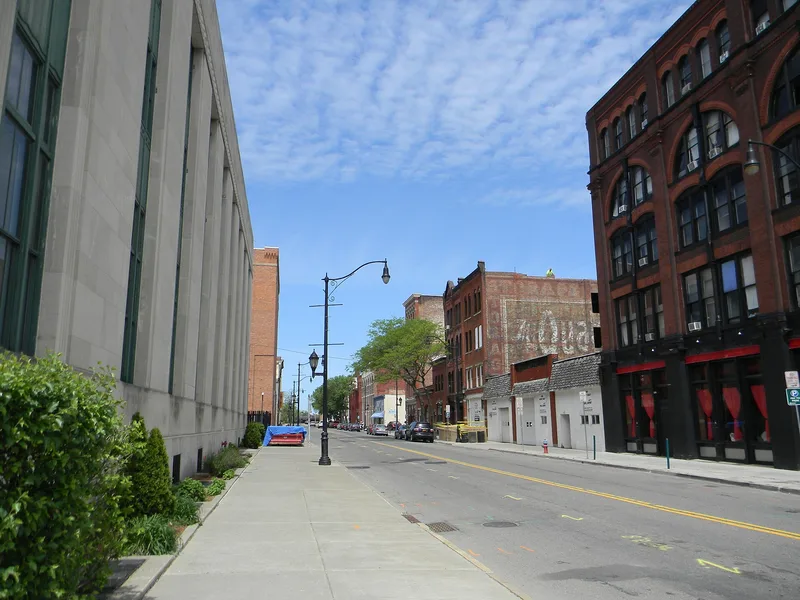
North of Binghamton's downtown, a group of 22 buildings along State and Henry Streets preserves the city's late nineteenth and early twentieth century commercial and industrial character. Most are brick, averaging four stories, and many show Romanesque detail such as arcaded facades, corbelled cornices and cast-iron storefronts. Notable buildings include the castellated State Armory, the Republican Building with its corner tower, the six-story Gaylord Building, the Hull-Grummond cigar company complex and the limestone Post Office and Courthouse of 1935. The area grew up along the Chenango Canal, which followed the path of State Street until it closed in 1877. Rail connections and a population surge in the 1880s then brought a new wave of construction. Businesses here included cigar makers, print shops, grocers, a candy factory and a nail factory. The district is considered significant for its uniform scale, uninterrupted streetscapes and the integrity of its buildings. Today many serve as warehouses, offices and apartments.
Significance in brief: The district is argued to be architecturally significant as an intact, cohesive group of buildings reflecting Binghamton's growth after rail expansion replaced the Chenango Canal. It shows a cross-section of the city's manufacturing and commercial life and styles from Romanesque to Art Deco. Uniform scale, continuous streetscapes and high integrity are also cited.
Machine-generated summary. This summary was generated by a language model from the official nomination document and has not been reviewed line by line by an editor. It may contain errors. Check the source document before relying on any detail. Source: nomination document (PDF) · National Archives catalog entry. NRHP reference 86001384, listed June 25, 1986. Summary generated October 2026 (model claude-sonnet-5-5, prompt v1.0-2026-10-29, confidence high).
Key facts
| Address | Roughly bounded by Lewis St., Prospect Ave., Henry St., and Water and Washington Sts., Binghamton |
|---|---|
| County | Broome County |
| Listed | June 25, 1986 |
| Reference number | 86001384 |
| Resource type | District |
| Period of significance | 1877-1935 |
| Architectural style | Romanesque, Queen Anne, Neoclassical, Beaux-Arts and Art Deco commercial, industrial and institutional buildings |
| Areas of significance | Architecture |
| Level of significance | Local |
| Status (as stated in the nomination) | Many buildings now serve as warehouses with some office and commercial space; at least two have upper-story apartments, and the Post Office and Courthouse still houses federal offices. Condition is marked fair. |
| Acreage | 7 |
| Coordinates | 42.10181, -75.91256 (NPS GIS) |
What listing means for this property
This is a historic district. Buildings within its boundary are either contributing (they add to the district's significance) or non-contributing. Owners of contributing income-producing buildings can claim the 20% federal rehabilitation tax credit; homeowners should look at state credits. National Register districts impose no design review by themselves; a local historic district ordinance, if one exists, does (the difference explained).
General information, not legal or tax advice. Rules change; confirm with your State Historic Preservation Office or a qualified adviser.
Sources and further reading
- National Park Service, National Register of Historic Places database (snapshot May 2026), reference 86001384.
- Nomination form (PDF, National Archives) — catalog entry
- Wikipedia article (used for cross-checking only; text not reproduced here)
- Wikidata Q14707351
- This listing as JSON
Last updated October 2026. Found an error? See the editorial policy for how to report it.