Railroad Terminal Historic District

Why it's listed
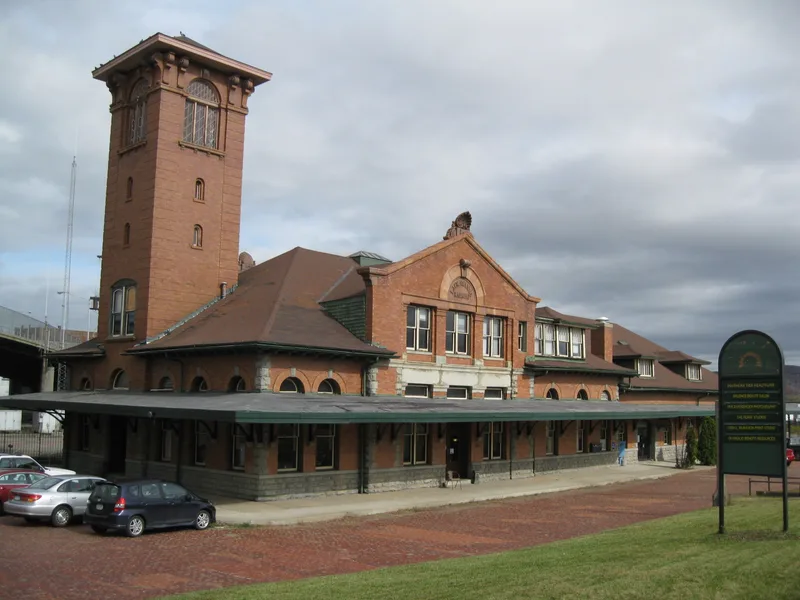
Several blocks north of downtown Binghamton, a cluster of brick buildings records the city's years as a railroad hub. The district holds 19 contributing buildings put up between 1876 and 1910, plus a 1932 addition, arranged around the rail yards that cross Chenango Street. They include the 1901 Lackawanna passenger station with its Italian Renaissance campanile, freight houses for the Erie and the Delaware and Hudson, the six-story Kilmer Building of 1903, the 1910 Newell and Truesdall grocery warehouse, and rows of Victorian warehouses and commercial blocks with corbelled cornices and cast-iron storefronts. Four railroads, the Erie, the Syracuse Binghamton and New York, the Delaware and Hudson, and the Lackawanna, built stations and freight houses close together here. The district matters as the commercial and industrial center of that rail era and as an unusually intact group of buildings. Passenger service has ended and most commercial freight moved to trucks, leaving the railroad buildings vacant or used for storage.
Significance in brief: It was the center of Binghamton's railroad-oriented commerce and industry between 1876 and 1932. It is a rare and largely intact concentration of architecturally distinguished railroad buildings, warehouses and commercial-residential buildings. Few other upstate New York cities retain terminal areas with this degree of integrity.
Machine-generated summary. This summary was generated by a language model from the official nomination document and has not been reviewed line by line by an editor. It may contain errors. Check the source document before relying on any detail. Source: nomination document (PDF) · National Archives catalog entry. NRHP reference 86000488, listed March 20, 1986. Summary generated October 2026 (model claude-sonnet-5-5, prompt v1.0-2026-10-29, confidence high).
Key facts
| Address | Intersection of Chenango St. and Erie-Lackawanna RR tracks, Binghamton |
|---|---|
| County | Broome County |
| Listed | March 20, 1986 |
| Reference number | 86000488 |
| Resource type | District |
| Period of significance | 1876-1932 |
| Architectural style | Late Victorian (Romanesque and Queen Anne influenced), Italian Renaissance, Beaux-Arts classicism, Neoclassical and Neo-Georgian |
| Areas of significance | Industry, Transportation, Architecture |
| Level of significance | Local |
| Status (as stated in the nomination) | The railroad buildings are now vacant or largely used for storage; many commercial buildings are vacant or underused. Most buildings survive with moderate to excellent integrity. |
| Acreage | 18 |
| Coordinates | 42.10472, -75.90603 (NPS GIS) |
What listing means for this property
This is a historic district. Buildings within its boundary are either contributing (they add to the district's significance) or non-contributing. Owners of contributing income-producing buildings can claim the 20% federal rehabilitation tax credit; homeowners should look at state credits. National Register districts impose no design review by themselves; a local historic district ordinance, if one exists, does (the difference explained).
General information, not legal or tax advice. Rules change; confirm with your State Historic Preservation Office or a qualified adviser.
Sources and further reading
- National Park Service, National Register of Historic Places database (snapshot May 2026), reference 86000488.
- Nomination form (PDF, National Archives) — catalog entry
- Wikipedia article (used for cross-checking only; text not reproduced here)
- Wikidata Q7284079
- This listing as JSON
Last updated October 2026. Found an error? See the editorial policy for how to report it.