Morgan-Wells House
Also known as: Quincy YMCA Building
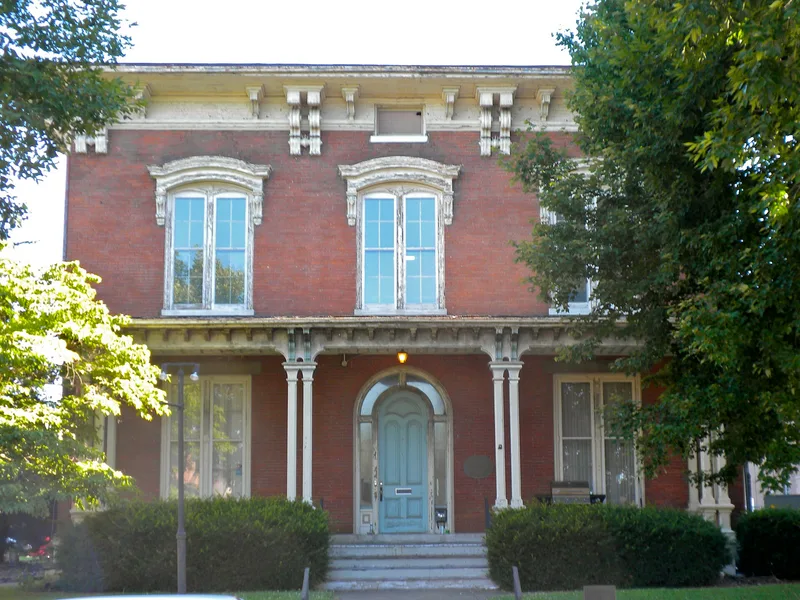

Approximate location: the National Park Service places this pin arbitrarily within the property, not at a surveyed point (stated accuracy ±12 m).
Why it's listed
Brick and limestone make up this Italianate house on Jersey Street in Quincy, Illinois, a large two-story residence with an attic, a hip roof and a full-width front porch. Local tradition places the oldest section in 1857, with the main front block added around 1860. Inside, a central hall holds an oval open-well stair, and the library was remodeled about 1875 with carved woodwork. Edward Wells, a pork packer who influenced the legislation for a Mississippi railroad bridge at Quincy, lived here with his family and that of James D. Morgan, a Civil War general who served under Sherman and later took part in the city's civic affairs. In 1901 the property became the Cheerful Home settlement house, and a gymnasium was built behind it. The Quincy YWCA bought it in 1933 and still uses it. A 1945 tornado removed the cupola, and a roughly 1950 addition enclosed the interior courtyard.
Significance in brief: The nomination argues it is architecturally significant as a typical large, elegant Italianate house of mid-nineteenth-century Quincy. It is historically significant as the home of Edward Wells and Gen. James D. Morgan, two prominent businessmen and leaders, and for its long social and humanitarian use as the Cheerful Home settlement house and the Quincy YWCA.
Machine-generated summary. This summary was generated by a language model from the official nomination document and has not been reviewed line by line by an editor. It may contain errors. Check the source document before relying on any detail. Source: nomination document (PDF) · National Archives catalog entry. NRHP reference 77000471, listed November 16, 1977. Summary generated October 2026 (model claude-sonnet-5-5, prompt v1.0-2026-10-29, confidence medium).
Key facts
| Address | 421 Jersey St., Quincy |
|---|---|
| County | Adams County |
| Listed | November 16, 1977 |
| Reference number | 77000471 |
| Resource type | Building |
| Period of significance | 1800-1899 |
| Architect / builder | Unknown; the partnership of Eaton Littlefield and George Baughman may have designed and built it (amended statement) |
| Architectural style | Italianate |
| Areas of significance | Military, Politics/Government, Architecture, Social History |
| Level of significance | State |
| Status (as stated in the nomination) | Occupied and in good condition; used by the Quincy YWCA since 1933, with alterations including a circa 1950 addition and a 1901 gymnasium. |
| Acreage | 0.6 |
| Within district | Downtown Quincy Historic District |
| Coordinates | 39.93104, -91.40904 (NPS GIS) |
What listing means for this property
National Register listing is honorary for a privately owned home: it does not by itself restrict what an owner may do with their own money, and it does not require public access. Restrictions come from local landmark or historic-district ordinances, which are separate (how they differ).
Owner-occupied houses are not eligible for the 20% federal rehabilitation tax credit, which applies to income-producing buildings, but many states offer credits for homeowners. Listing also opens the door to preservation easements and to buying a plaque. Start with what listing means for homeowners, renovating a listed house and selling one.
General information, not legal or tax advice. Rules change; confirm with your State Historic Preservation Office or a qualified adviser.
Sources and further reading
- National Park Service, National Register of Historic Places database (snapshot May 2026), reference 77000471.
- Nomination form (PDF, National Archives) — catalog entry
- Wikipedia article (used for cross-checking only; text not reproduced here)
- Wikidata Q6911556
- This listing as JSON
Last updated October 2026. Found an error? See the editorial policy for how to report it.