Downtown Quincy Historic District

Why it's listed
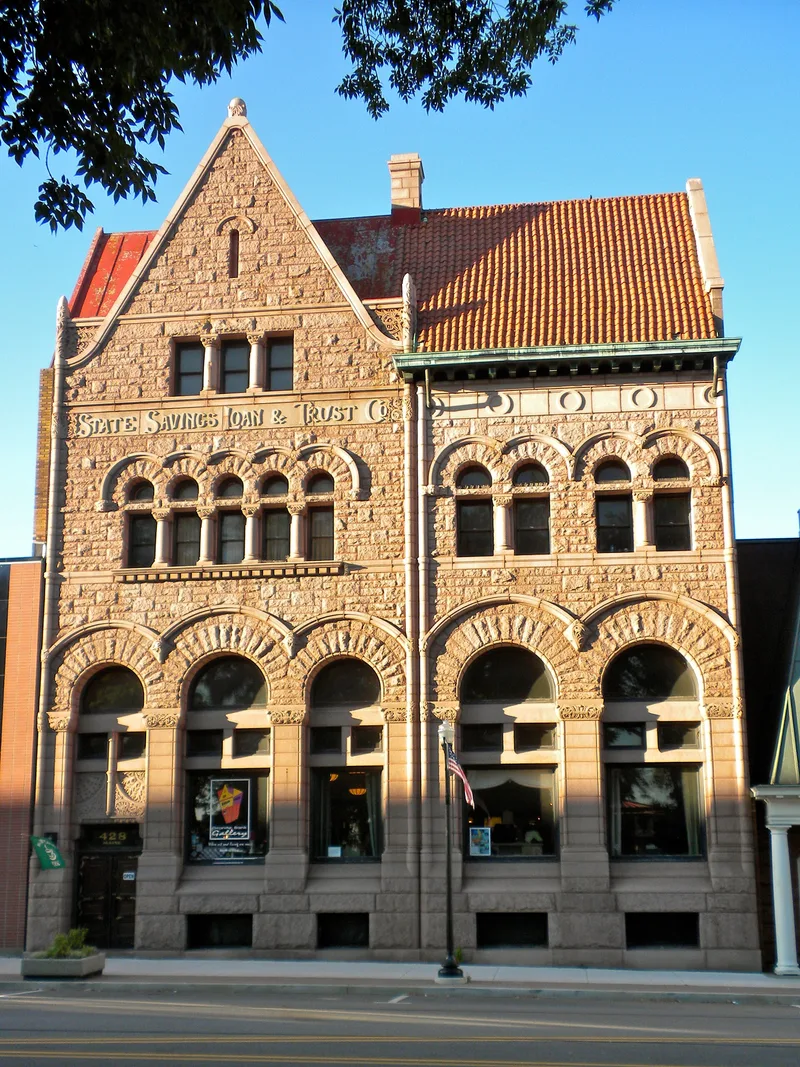
Downtown Quincy, on the Mississippi River bluffs in western Illinois, is a commercial district of contiguous two- and three-story buildings, with taller landmarks mixed in. Roughly bounded by Hampshire, Jersey, 4th and 8th Streets, it grew from an 1825 settlement of wooden structures into a business center rebuilt between 1850 and 1930. Italianate and Commercial buildings dominate, alongside Renaissance Revival, Romanesque Revival, Art Deco, Byzantine and other styles. Notable examples include the nine-story Lincoln-Douglas Hotel of 1930, the 1876 Ricker Bank, the 1924 Washington Theatre, the ten-story WCU Building of 1925 and the 1859 St. John's Episcopal Church. Many buildings retain cast-iron and plate glass storefronts and original upper stories. The district was listed because of its architectural variety and integrity, and because it reflects the work of German builders and artisans and the commercial and political life of a river city tied to the Lincoln-Douglas debates and the anti-slavery movement.
Significance in brief: The district preserves a second-generation building boom of 1850 to 1930 that replaced the original wooden structures of the 1820s. It shows a wide range of architectural styles, led by Italianate and Commercial, and keeps a high degree of physical integrity. The text also ties the architecture to Quincy's German builders and artisans, and to the city's commercial, political and anti-slavery history, including the 1858 Lincoln-Douglas debate.
Machine-generated summary. This summary was generated by a language model from the official nomination document and has not been reviewed line by line by an editor. It may contain errors. Check the source document before relying on any detail. Source: nomination document (PDF) · National Archives catalog entry. NRHP reference 83000298, listed April 7, 1983. Summary generated October 2026 (model claude-sonnet-5-5, prompt v1.0-2026-10-29, confidence medium).
Key facts
| Address | Roughly bounded by Hampshire, Jersey, 4th and 8th Sts., Quincy |
|---|---|
| County | Adams County |
| Listed | April 7, 1983 |
| Reference number | 83000298 |
| Resource type | District |
| Period of significance | 1850-1930 |
| Architect / builder | Various, including C.W. Nichol, J.S. McKean, Reuben Levin, Ernest Wood, I.S. Taylor, Patton and Fischer, Martin Geise, George Behrensmeyer, William Raley, John Batschy and Charles Howland |
| Architectural style | Predominantly Italianate and Commercial, with Renaissance Revival, Queen Anne, Romanesque Revival, Second Empire, Art Deco, Byzantine, Sullivanesque and many others |
| Areas of significance | Commerce, Architecture |
| Level of significance | State |
| Status (as stated in the nomination) | Condition is marked excellent, fair and deteriorated, and the buildings are both occupied and unoccupied. Some buildings, such as the Halbach-Schroeder Building and the Doerr Opera House, are described as vacant. |
| Acreage | 24 |
| Coordinates | 39.93274, -91.40802 (NPS GIS) |
What listing means for this property
This is a historic district. Buildings within its boundary are either contributing (they add to the district's significance) or non-contributing. Owners of contributing income-producing buildings can claim the 20% federal rehabilitation tax credit; homeowners should look at state credits. National Register districts impose no design review by themselves; a local historic district ordinance, if one exists, does (the difference explained).
General information, not legal or tax advice. Rules change; confirm with your State Historic Preservation Office or a qualified adviser.
Sources and further reading
- National Park Service, National Register of Historic Places database (snapshot May 2026), reference 83000298.
- Nomination form (PDF, National Archives) — catalog entry
- Wikipedia article (used for cross-checking only; text not reproduced here)
- Wikidata Q14687485
- This listing as JSON
Last updated October 2026. Found an error? See the editorial policy for how to report it.