Flood, James C., Mansion
Also known as: Pacific Union Club

Why it's listed
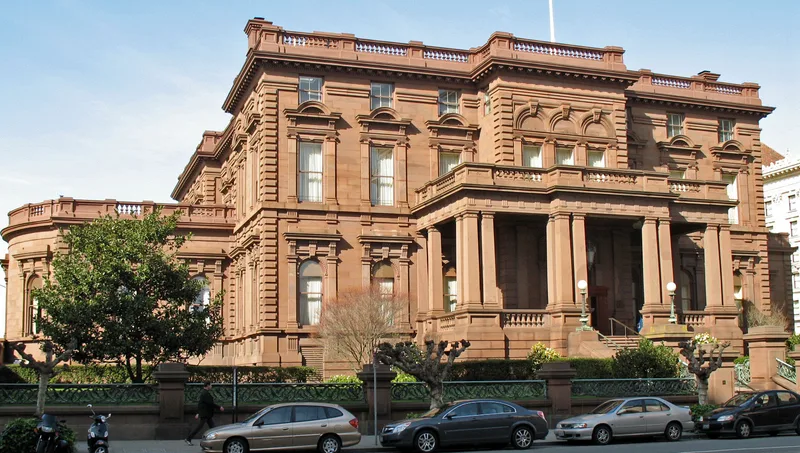
Built in 1886 on San Francisco's Nob Hill, this 42-room brownstone mansion was designed by Augustus Laver as the townhouse of James C. Flood, a Comstock mining magnate. Precut sandstone was brought from Connecticut and shipped around the Horn. A bronze fence around the property still stands on three sides. Flood had made his fortune with partners in the Consolidated Virginia Mine, whose 1873 bonanza became one of the richest finds of gold and silver ore. When the 1906 earthquake and fire swept the hill, the other mansions, built of wood, were destroyed. The Flood house lost its interior, but its stone shell survived. The Pacific Union Club bought it in 1909, and Willis Polk remodeled the interior and added semicircular wings and a third floor in 1910, using stone from the same Connecticut quarry. It is significant as the sole surviving Nob Hill palace and a reminder of the Comstock fortunes.
Significance in brief: It is the only one of the Nob Hill mansions to survive the 1906 earthquake and fire. It commemorates James Flood, one of the Comstock Bonanza Kings, and an era when great fortunes were made in speculation and mining. Its 1886 construction and the 1910 remodeling by Willis Polk mark two phases of its history.
Machine-generated summary. This summary was generated by a language model from the official nomination document and has not been reviewed line by line by an editor. It may contain errors. Check the source document before relying on any detail. Source: nomination document (PDF) · National Archives catalog entry. NRHP reference 66000230, listed November 13, 1966. Summary generated October 2026 (model claude-sonnet-5-5, prompt v1.0-2026-10-29, confidence medium).
Key facts
| Address | California and Mason Sts., San Francisco |
|---|---|
| County | San Francisco |
| Listed | November 13, 1966 |
| Reference number | 66000230 |
| Resource type | Building |
| Period of significance | 1800-1899, 1900- |
| Architect / builder | Augustus Laver, Willis Polk |
| Areas of significance | Commerce |
| Level of significance | National |
| National Historic Landmark | Yes, designated November 13, 1966 |
| Status (as stated in the nomination) | Occupied by the Pacific Union Club, a private club; condition marked excellent and altered. |
| Acreage | 1.3 |
| Coordinates | 37.79227, -122.41141 (NPS GIS) |
What listing means for this property
National Register listing is honorary for a privately owned home: it does not by itself restrict what an owner may do with their own money, and it does not require public access. Restrictions come from local landmark or historic-district ordinances, which are separate (how they differ).
Owner-occupied houses are not eligible for the 20% federal rehabilitation tax credit, which applies to income-producing buildings, but many states offer credits for homeowners. Listing also opens the door to preservation easements and to buying a plaque. Start with what listing means for homeowners, renovating a listed house and selling one.
General information, not legal or tax advice. Rules change; confirm with your State Historic Preservation Office or a qualified adviser.
Sources and further reading
- National Park Service, National Register of Historic Places database (snapshot May 2026), reference 66000230.
- Nomination form (PDF, National Archives) — catalog entry
- Wikipedia article (used for cross-checking only; text not reproduced here)
- Wikidata Q6130704
- This listing as JSON
Last updated October 2026. Found an error? See the editorial policy for how to report it.