Harada House

Why it's listed
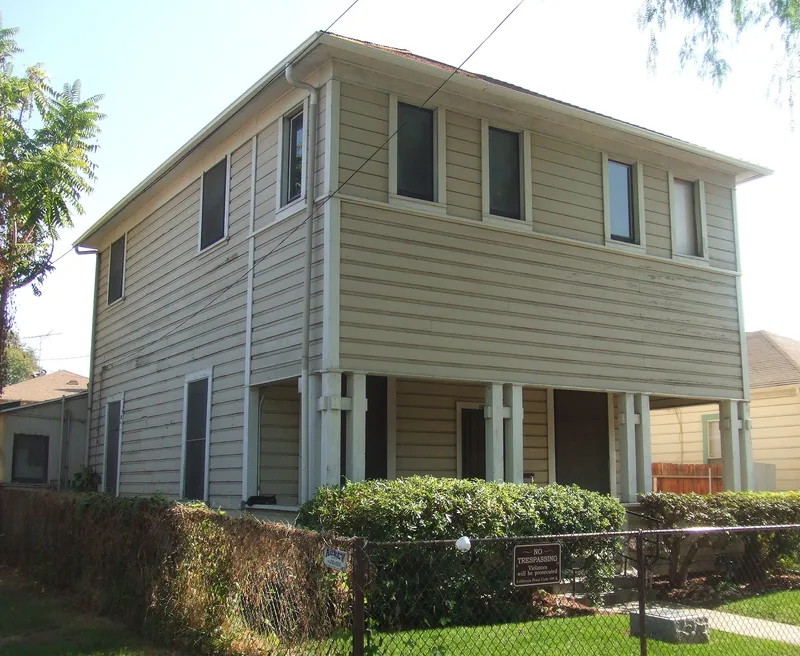
Originally a single-story saltbox cottage with shiplap siding and a wood shingle roof, this Riverside house at 3356 Lemon Street was expanded in 1916 with a second story containing four bedrooms and a bathroom. The earliest record of the building dates to 1893-94, and the ground floor may date to the 1880s. In December 1915, Jukichi Harada, a Japanese immigrant barred from citizenship and from owning land under California's Alien Land Law of 1913, bought the home in the names of his three American-born children. Neighbors objected, and the State of California sued to seize the property. The case, The People of California vs. Harada, drew attention as far as Japan. In 1918 Judge Hugh Craig ruled for the family, holding that American-born children were entitled to full constitutional protections. The house remained in the family through World War II, and its 1916 alterations survive largely intact.
Significance in brief: The house was at the center of The People of California vs. Harada (1916-1918), the first test of the constitutionality of an alien land law in the United States. Jukichi Harada, ineligible for citizenship, put the property in the names of his American-born children. The court ruled in the family's favor, reinforcing the constitutional guarantees of American citizenship for children of immigrants.
Machine-generated summary. This summary was generated by a language model from the official nomination document and has not been reviewed line by line by an editor. It may contain errors. Check the source document before relying on any detail. Source: nomination document (PDF) · National Archives catalog entry. NRHP reference 77000325, listed September 15, 1977. Summary generated October 2026 (model claude-sonnet-5-5, prompt v1.0-2026-10-29, confidence medium).
Key facts
| Address | 3356 Lemon St., Riverside |
|---|---|
| County | Riverside County |
| Listed | September 15, 1977 |
| Reference number | 77000325 |
| Resource type | Building |
| Period of significance | 1916+ |
| Architect / builder | Original builder unknown; 1916 alteration by Harp Brothers |
| Areas of significance | Asian, Law, Politics/Government |
| Level of significance | National |
| National Historic Landmark | Yes, designated December 14, 1990 |
| Status (as stated in the nomination) | Condition is marked as altered and the property is listed as occupied; most 1916 interior features reportedly remain intact. The house remained in the Harada family through World War II. |
| Acreage | 0.1 |
| Coordinates | 33.98509, -117.36899 (NPS GIS) |
What listing means for this property
National Register listing is honorary for a privately owned home: it does not by itself restrict what an owner may do with their own money, and it does not require public access. Restrictions come from local landmark or historic-district ordinances, which are separate (how they differ).
Owner-occupied houses are not eligible for the 20% federal rehabilitation tax credit, which applies to income-producing buildings, but many states offer credits for homeowners. Listing also opens the door to preservation easements and to buying a plaque. Start with what listing means for homeowners, renovating a listed house and selling one.
General information, not legal or tax advice. Rules change; confirm with your State Historic Preservation Office or a qualified adviser.
Sources and further reading
- National Park Service, National Register of Historic Places database (snapshot May 2026), reference 77000325.
- Nomination form (PDF, National Archives) — catalog entry
- Wikipedia article (used for cross-checking only; text not reproduced here)
- Wikidata Q5653555
- This listing as JSON
Last updated October 2026. Found an error? See the editorial policy for how to report it.