Kennedy-Wade Mill
Also known as: Wade`s Mill

Why it's listed
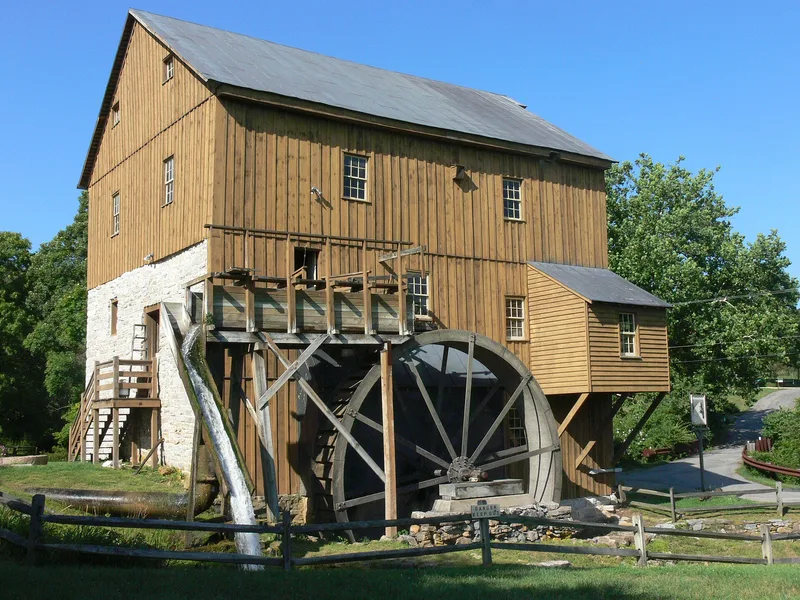
Along Otts Creek northeast of Brownsburg, this gristmill rises three stories plus an attic. Its lower two stories are coursed rubble limestone on three sides, and the rest is board-and-batten framing. A Fitz-type overshot iron wheel sits on the long frame side. The stone portion may have been built early in the 19th century by Andrew Kennedy, who acquired the land in 1799. A mill is first mentioned there in 1811. After a fire in 1873 the upper story was added, giving the building its present form. The Wade family bought it in 1882 and installed roller milling machinery early in the 20th century. Equipment from several manufacturers remains in place, and a portion of the iron conduit race survives. The nominated area also holds a miller's house, a tenant house, a garage, a shed, a small pond and the old dam site. The mill is valued as the most complete operable gristmill in Rockbridge County.
Significance in brief: The nomination calls it the most complete, operable example of a gristmill in Rockbridge County. Its collection of milling machinery is significant for industrial archaeology. The grist mill is described as the most essential supportive industry of the agrarian society of 19th- and 20th-century western Virginia. The associated houses, outbuildings and dam site are counted as part of the original energy system and complex.
Machine-generated summary. This summary was generated by a language model from the official nomination document and has not been reviewed line by line by an editor. It may contain errors. Check the source document before relying on any detail. Source: nomination document (PDF) · National Archives catalog entry. NRHP reference 79003296, listed July 13, 1979. Summary generated October 2026 (model claude-sonnet-5-5, prompt v1.0-2026-10-29, confidence high).
Key facts
| Address | 2.3 mi. NE of Brownsburg on VA 606, Brownsburg |
|---|---|
| County | Rockbridge County |
| Listed | July 13, 1979 |
| Reference number | 79003296 |
| Resource type | District |
| Period of significance | 1800-1899 and 1900- (both periods appear in the form) |
| Architect / builder | Andrew Kennedy (stone portion possibly built by him) |
| Areas of significance | Industry, Commerce, Historic - Non-Aboriginal, Agriculture |
| Level of significance | State |
| Status (as stated in the nomination) | Condition is marked excellent and altered. The mill retains operable machinery, including the original hoist, which still works. |
| Acreage | 10 |
| Within district | Kennedy-Wade's Mill Historic District (Boundary Increase) |
| Coordinates | 37.95065, -79.28624 (NPS GIS) |
What listing means for this property
This is a historic district. Buildings within its boundary are either contributing (they add to the district's significance) or non-contributing. Owners of contributing income-producing buildings can claim the 20% federal rehabilitation tax credit; homeowners should look at state credits. National Register districts impose no design review by themselves; a local historic district ordinance, if one exists, does (the difference explained).
General information, not legal or tax advice. Rules change; confirm with your State Historic Preservation Office or a qualified adviser.
Sources and further reading
- National Park Service, National Register of Historic Places database (snapshot May 2026), reference 79003296.
- Nomination form (PDF, National Archives) — catalog entry
- Wikipedia article (used for cross-checking only; text not reproduced here)
- Wikidata Q6389577
- This listing as JSON
Last updated October 2026. Found an error? See the editorial policy for how to report it.