New Providence Presbyterian Church

Why it's listed
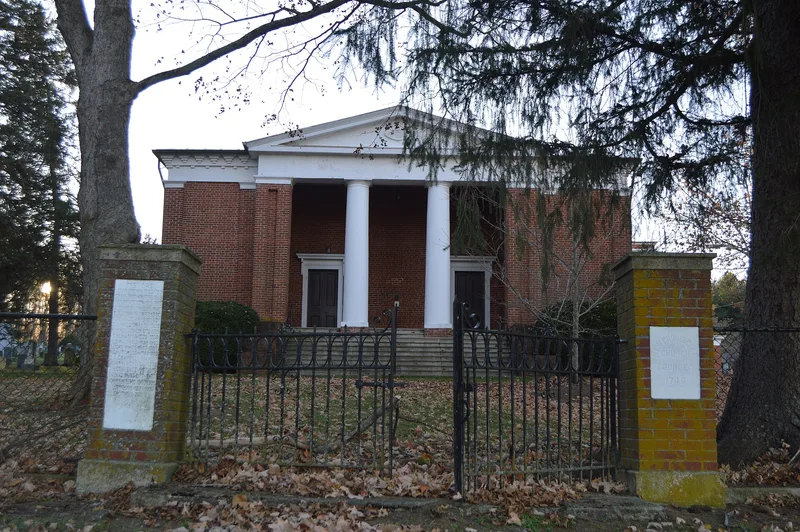
Set beside a quiet country road in rural Rockbridge County, this one-story brick church was completed in 1859 and is Greek Revival in style. Its facade has a recessed central portico with a pediment carried on two massive, unfluted Doric columns, plain pilasters, and a low hipped roof. Inside, a single large auditorium has galleries and a central pulpit backed by a tabernacle of Doric pilasters with plaster foliage. The plan and interior were freely adapted from Asher Benjamin's The Builder's Guide of 1839. The exterior closely resembles churches at Tinkling Springs and Hampden-Sydney designed by the pastor Robert L. Dabney, who may have influenced this one. The congregation dates to 1746 and this is its fifth building. Its early minister John Brown kept a school that grew into Washington and Lee University, and a women's missionary society formed here in 1819. A Sunday School wing was added in 1926, and the church remains active.
Significance in brief: It is a distinguished Greek Revival church closely resembling the Tinkling Springs and Hampden-Sydney churches designed by the pastor Robert L. Dabney, and its interior is little altered. The design was freely adapted from Asher Benjamin's The Builder's Guide (1839). The congregation, organized in 1746, played a role in establishing the Synod of Virginia and sponsored an early missionary society.
Machine-generated summary. This summary was generated by a language model from the official nomination document and has not been reviewed line by line by an editor. It may contain errors. Check the source document before relying on any detail. Source: nomination document (PDF) · National Archives catalog entry. NRHP reference 80004223, listed March 26, 1980. Summary generated October 2026 (model claude-sonnet-5-5, prompt v1.0-2026-10-29, confidence high).
Key facts
| Address | NE of Brownsburg, Brownsburg |
|---|---|
| County | Rockbridge County |
| Listed | March 26, 1980 |
| Reference number | 80004223 |
| Resource type | Building |
| Period of significance | 1859 |
| Architectural style | Greek Revival |
| Areas of significance | Architecture |
| Level of significance | State |
| Status (as stated in the nomination) | Still an active congregation; the structure is carefully maintained and the interior has been little altered. |
| Acreage | 2 |
| Coordinates | 37.95166, -79.30263 (NPS GIS) |
What listing means for this property
Religious properties are listed for their architectural or historical significance, not their religious use. Listing is honorary and does not restrict the congregation's use of the building. The federal rehabilitation credit is generally unavailable unless part of the building is income-producing; some state programmes and preservation grants do cover religious buildings. Federal funding or permits trigger Section 106 review.
General information, not legal or tax advice. Rules change; confirm with your State Historic Preservation Office or a qualified adviser.
Sources and further reading
- National Park Service, National Register of Historic Places database (snapshot May 2026), reference 80004223.
- Nomination form (PDF, National Archives) — catalog entry
- Wikipedia article (used for cross-checking only; text not reproduced here)
- Wikidata Q14712957
- This listing as JSON
Last updated October 2026. Found an error? See the editorial policy for how to report it.