Kennedy-Wade's Mill Historic District (Boundary Increase)

Why it's listed
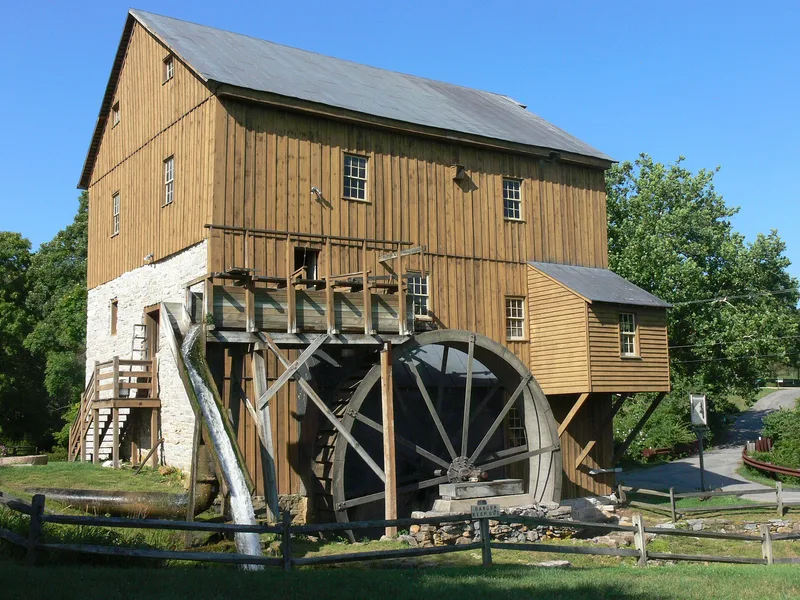
Along Otts Creek near Raphine in Rockbridge County, a cluster of farm and mill buildings spread across about 113 acres forms a working mill community of the Shenandoah Valley. The centerpiece is a three-story gristmill of limestone and board-and-batten frame, rebuilt around 1877 after a fire and still fed by an overshot wheel. Nearby stand a Flemish-bond brick farmhouse from about 1793, enlarged in 1841, a frame miller's house expanded in the 1890s, an assistant miller's house of 1900, and a frame I-house of 1913 built by a former assistant miller. Springhouses, bank barns, smokehouses, chickenhouses and a corncrib complete the group. Together they illustrate vernacular building forms in western Virginia from the late eighteenth to the early twentieth century, and they record how milling shaped local farming and trade. The surrounding landscape remains rural, which preserves the setting of one of the region's few continuously operating mills.
Machine-generated summary. This summary was generated by a language model from the official nomination document and has not been reviewed line by line by an editor. It may contain errors. Check the source document before relying on any detail. Source: nomination document (PDF) · catalog entry. Generated October 2026 (model claude-sonnet-5-5, prompt v1.0-2026-10-29).
| Period of significance | ca. 1793-1913 |
|---|---|
| Styles | Early Republic/Federal; I-house |
| Areas of significance | Architecture, Industry |
| Acreage | 103 |
| Boundary source | NPS cultural-resource GIS polygon |
| Full listing page | Kennedy-Wade's Mill Historic District (Boundary Increase) (property record) |
What listing means for this property
This is a historic district. Buildings within its boundary are either contributing (they add to the district's significance) or non-contributing. Owners of contributing income-producing buildings can claim the 20% federal rehabilitation tax credit; homeowners should look at state credits. National Register districts impose no design review by themselves; a local historic district ordinance, if one exists, does (the difference explained).
General information, not legal or tax advice. Rules change; confirm with your State Historic Preservation Office or a qualified adviser.