Cartersville Bridge

Why it's listed
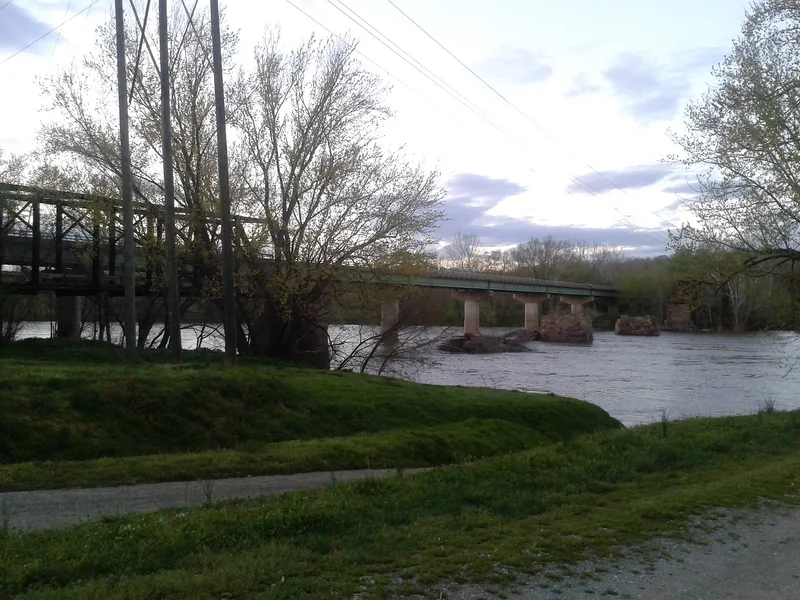
Carrying Route 45 across the James River between Cartersville and Pemberton, this bridge combined heavy timber members with cast-iron connections in a truss based on the Pratt design. It had six spans and an overall length of 843 feet, with a timber-surfaced roadway thirteen feet wide. The stone piers and abutments came from the first bridge, a wooden covered structure built under contractor David Scott after the Cartersville Bridge Company was chartered in 1819 and completed in 1822. That bridge proved poorly built, and a diarist in 1827 judged its arches to be failing. A second bridge followed in 1841-1842, then a ferry served the crossing until the superstructure was rebuilt in the 1880s with combined iron and wood. Its rare composite construction and its standing as the last major timber bridge over the James River made it an engineering landmark. A flood in June 1972 left only two end spans and the piers.
Significance in brief: It was described as the last major timber bridge across the James River. Its heavy timber framing with cast-iron connections, based on a Pratt truss, is a rare example of composite construction. Together with the 1822 stone piers and abutments, it is called an important engineering landmark.
Machine-generated summary. This summary was generated by a language model from the official nomination document and has not been reviewed line by line by an editor. It may contain errors. Check the source document before relying on any detail. Source: nomination document (PDF) · National Archives catalog entry. NRHP reference 72001390, listed September 14, 1972. Summary generated October 2026 (model claude-sonnet-5-5, prompt v1.0-2026-10-29, confidence medium).
Key facts
| Address | VA 45 over James River, Cartersville |
|---|---|
| County | Cumberland County |
| Listed | September 14, 1972 |
| Reference number | 72001390 |
| Resource type | Structure |
| Period of significance | 19th Century (specific dates 1822, 1842, 1883) |
| Architect / builder | David Scott of Maryland (contractor, first bridge, 1820); Joseph N. Carrington (contractor, second bridge, 1842) |
| Architectural style | Composite timber and cast-iron truss construction, based on the Pratt truss |
| Areas of significance | Engineering, Transportation |
| Level of significance | State |
| Status (as stated in the nomination) | Damaged by flood in June 1972; only two end spans and the stone piers remain. Earlier described as in good condition, altered, with the floor beams replaced in 1955. |
| Acreage | 0.9 |
| Coordinates | 37.67024, -78.08700 (NPS GIS) |
What listing means for this property
For a publicly owned building or structure, listing mainly matters when federal funds, permits or licences are involved: projects then go through Section 106 review so effects on the property are considered. Listing also strengthens applications for preservation grants and, for leased income-producing uses, can enable the federal rehabilitation tax credit.
General information, not legal or tax advice. Rules change; confirm with your State Historic Preservation Office or a qualified adviser.
Sources and further reading
- National Park Service, National Register of Historic Places database (snapshot May 2026), reference 72001390.
- Nomination form (PDF, National Archives) — catalog entry
- Wikipedia article (used for cross-checking only; text not reproduced here)
- Wikidata Q5047263
- This listing as JSON
Last updated October 2026. Found an error? See the editorial policy for how to report it.