Thomas Mill Covered Bridge
Also known as: See Also:Fairmount Park

Why it's listed
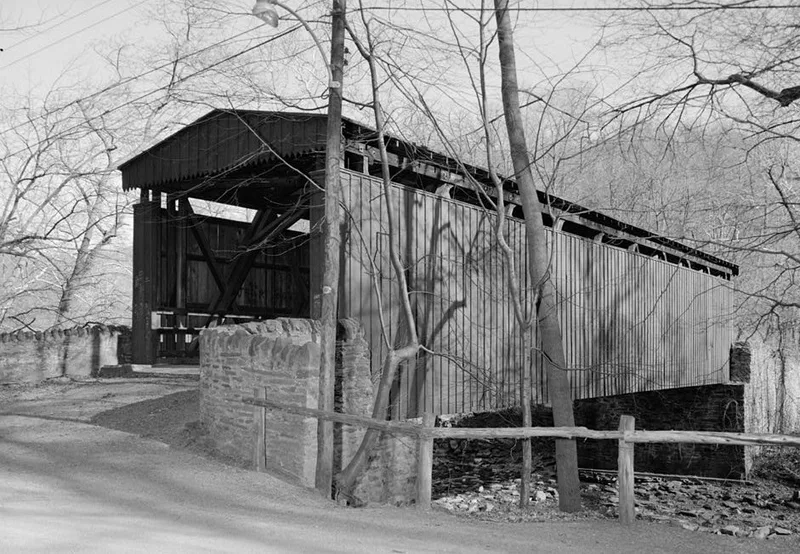
Spanning Wissahickon Creek within Fairmount Park in Philadelphia, this wooden covered bridge was built in 1855 and repaired by the city in 1939. It is a Howe truss structure measuring 86 feet 6 inches in length and 18 feet 8 inches in width. Its portals carry unusual saw-toothed decorations. The bridge is regarded as the oldest and longest of the four surviving Howe-truss covered bridges in Pennsylvania, and it is the only covered bridge in Philadelphia County. It is closed to traffic. The builder and architect are not identified in the available record, and the bridge's significance rests on its age, its truss type, and its rarity within the city and the state.
Significance in brief: The form states that the bridge is the oldest and longest of Pennsylvania's four remaining Howe-truss covered bridges and the only covered bridge in Philadelphia County. Its portals have unusual saw-toothed decorations.
Machine-generated summary. This summary was generated by a language model from the official nomination document and has not been reviewed line by line by an editor. It may contain errors. Check the source document before relying on any detail. Source: nomination document (PDF) · National Archives catalog entry. NRHP reference 80003621, listed December 1, 1980. Summary generated October 2026 (model claude-haiku-5-5, prompt v1.1-2026-10-29, confidence medium).
Key facts
| Address | Thomas Mill Rd., Philadelphia |
|---|---|
| County | Philadelphia |
| Listed | December 1, 1980 |
| Reference number | 80003621 |
| Resource type | Structure |
| Architectural style | Howe truss |
| Areas of significance | Engineering, Transportation |
| Level of significance | National |
| Status (as stated in the nomination) | Closed to traffic |
| Acreage | 0.9 |
| Within district | Fairmount Park |
| Coordinates | 40.07173, -75.22549 (NPS GIS) |
What listing means for this property
For a publicly owned building or structure, listing mainly matters when federal funds, permits or licences are involved: projects then go through Section 106 review so effects on the property are considered. Listing also strengthens applications for preservation grants and, for leased income-producing uses, can enable the federal rehabilitation tax credit.
General information, not legal or tax advice. Rules change; confirm with your State Historic Preservation Office or a qualified adviser.
Sources and further reading
- National Park Service, National Register of Historic Places database (snapshot May 2026), reference 80003621.
- Nomination form (PDF, National Archives) — catalog entry
- Wikipedia article (used for cross-checking only; text not reproduced here)
- Wikidata Q7792456
- This listing as JSON
Last updated October 2026. Found an error? See the editorial policy for how to report it.