Alfred Newton Richards Medical Research Laboratories and David Goddard Laboratories Buildings
Also known as: Biology Building
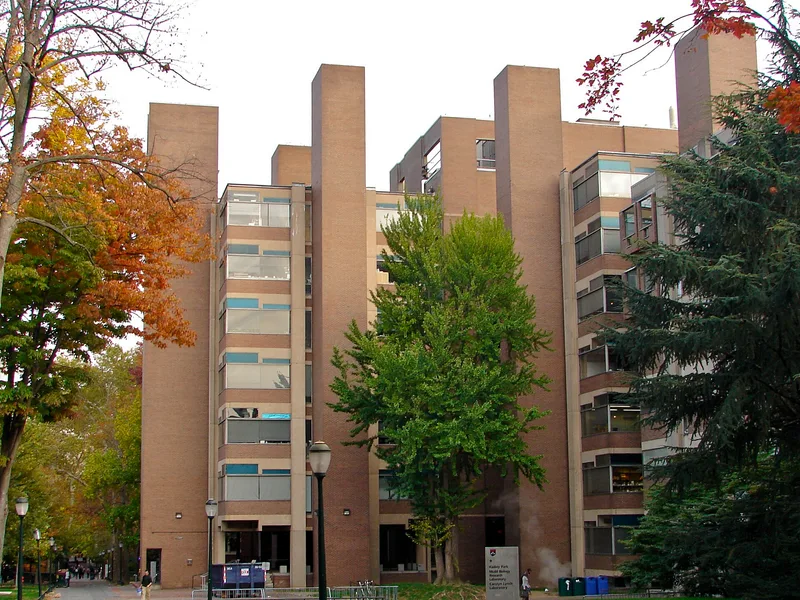

Why it's listed
Two connected laboratory and classroom buildings on the University of Pennsylvania campus in West Philadelphia, designed by Louis I. Kahn and built between 1957 and 1965 with a landscaped setting of brick plazas and steps. The Alfred Newton Richards Medical Research Laboratories were planned through the Medical School and the David Goddard Laboratories through the School of Arts and Sciences, and the two were designed as a single project. Their exteriors express the separation of 'served' laboratory towers from 'servant' service volumes, and the Vierendeel structural system of the served spaces is visible from outside, with exposed reinforced concrete, concrete block and brick. Contemporary critics saw the design as a direct alternative to the glass-box International Modernism then dominant, and placed Kahn among major American architects. The project was celebrated in architectural journals in 1959 and 1960 for its precast concrete and technical innovations. Its significance is regarded as having grown since completion, and the buildings retain a high degree of integrity in their key design features.
Significance in brief: The nomination argues the buildings are one of the most important works of Louis I. Kahn and an early full expression of his ideas, including the organization of buildings into 'servant' and 'served' spaces, the expression of structure in masonry and concrete, and a response to historic context. It states that contemporaries immediately recognized the design as an alternative to International Modernism, and that the project qualifies as nationally significant under the 50-year exception because its importance was recognized before completion.
Machine-generated summary. This summary was generated by a language model from the official nomination document and has not been reviewed line by line by an editor. It may contain errors. Check the source document before relying on any detail. Source: nomination document (PDF) · National Archives catalog entry. NRHP reference 09000081, listed January 16, 2009. Summary generated October 2026 (model claude-haiku-5-5, prompt v1.1-2026-10-29, confidence medium).
Key facts
| Address | 33700-3710 Hamilton Walk, University of Pennsylvania, Philadelphia |
|---|---|
| County | Philadelphia |
| Listed | January 16, 2009 |
| Reference number | 09000081 |
| Resource type | Building |
| Period of significance | 1957-1965 |
| Architect / builder | Kahn, Louis Isadore (1901-1974) |
| Architectural style | Modern Movement |
| Criteria |
|
| Areas of significance | Architecture |
| Level of significance | National |
| National Historic Landmark | Yes, designated January 16, 2009 |
| Status (as stated in the nomination) | The document states the buildings continue to serve their original program purposes, with Richards occupied by research laboratories and Goddard housing research and teaching laboratories, offices and classrooms. |
| Acreage | 2.8 |
| Coordinates | 39.94950, -75.19809 (NPS GIS) |
What listing means for this property
National Register listing is honorary: it recognises significance and does not restrict what a private owner may do without federal money or permits. It unlocks the 20% federal rehabilitation tax credit for income-producing buildings, state credits in many states, and Section 106 review when federal agencies are involved. See what listing means in practice.
General information, not legal or tax advice. Rules change; confirm with your State Historic Preservation Office or a qualified adviser.
Sources and further reading
- National Park Service, National Register of Historic Places database (snapshot May 2026), reference 09000081.
- Nomination form (PDF, National Archives) — catalog entry
- Wikipedia article (used for cross-checking only; text not reproduced here)
- Wikidata Q954769
- This listing as JSON
Last updated October 2026. Found an error? See the editorial policy for how to report it.