Woodlands, The

Why it's listed
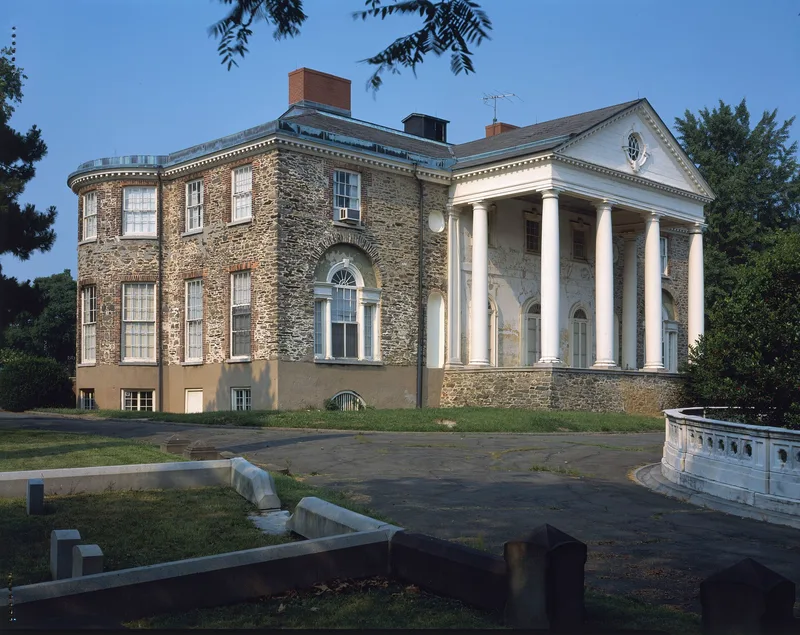
Set on a rise above the Schuylkill River in West Philadelphia, The Woodlands began as a country house for the botanist William Hamilton, who came of age in 1766. The mansion was first built around 1770 and expanded between 1786 and 1789 in an English country-house manner, with a south-facing monumental Doric portico and a north-facing pilastered pavilion. Its interiors, including a barrel-vaulted passage, circular reception hall and oval rooms, are regarded as among the most sophisticated neoclassical interiors in the country. Hamilton's pleasure gardens, which he developed in the English landscape style, were admired in his day, and Thomas Jefferson reportedly called them the only rival he knew in America to what could be seen in England. In 1840 the Woodlands Cemetery Company turned part of the grounds into a rural cemetery. The mansion and stable survive, and the cemetery holds a large collection of monuments spanning roughly 150 years of funerary design.
Significance in brief: The mansion is described as one of the preeminent neoclassical house interiors in the United States and as an important early example of a monumental portico in Philadelphia. Hamilton's garden in the English landscape tradition was regarded as one of the finest in North America. The later Woodlands Cemetery is presented as an early and significant contribution to the American rural cemetery movement and as a repository of funerary art.
Machine-generated summary. This summary was generated by a language model from the official nomination document and has not been reviewed line by line by an editor. It may contain errors. Check the source document before relying on any detail. Source: nomination document (PDF) · National Archives catalog entry. NRHP reference 67000022, listed December 24, 1967. Summary generated October 2026 (model claude-haiku-5-5, prompt v1.1-2026-10-29, confidence medium).
Key facts
| Address | 40th St. and Woodland Ave., Philadelphia |
|---|---|
| County | Philadelphia |
| Listed | December 24, 1967 |
| Reference number | 67000022 |
| Resource type | Building |
| Period of significance | 1766-ca.1898 |
| Architectural style | Early Classical Revival |
| Criteria |
|
| Areas of significance | Architecture |
| Level of significance | National |
| National Historic Landmark | Yes, designated December 24, 1967 |
| Acreage | 53.1 |
| Coordinates | 39.94692, -75.20339 (NPS GIS) |
What listing means for this property
National Register listing is honorary: it recognises significance and does not restrict what a private owner may do without federal money or permits. It unlocks the 20% federal rehabilitation tax credit for income-producing buildings, state credits in many states, and Section 106 review when federal agencies are involved. See what listing means in practice.
General information, not legal or tax advice. Rules change; confirm with your State Historic Preservation Office or a qualified adviser.
Sources and further reading
- National Park Service, National Register of Historic Places database (snapshot May 2026), reference 67000022.
- Nomination form (PDF, National Archives) — catalog entry
- Wikipedia article (used for cross-checking only; text not reproduced here)
- Wikidata Q7775731
- This listing as JSON
Last updated October 2026. Found an error? See the editorial policy for how to report it.