Mill Creek Historic District

Why it's listed
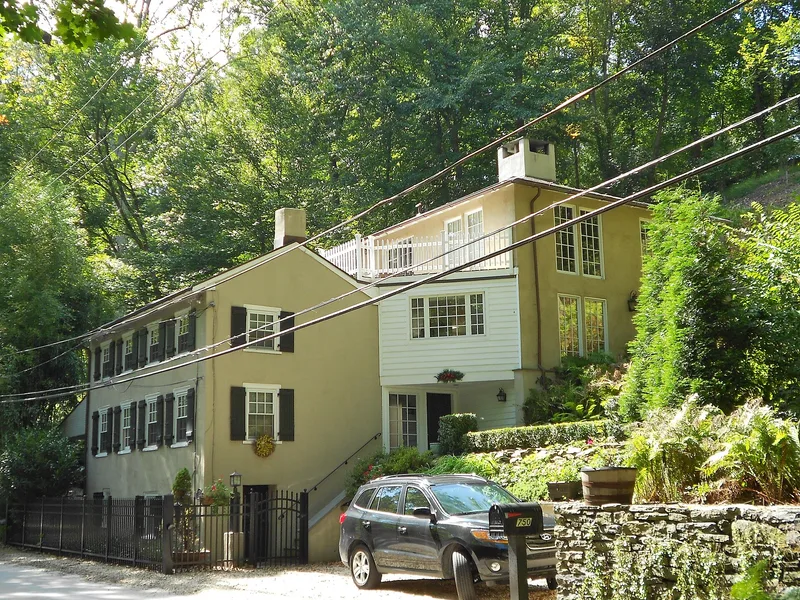
Mill Creek runs through a wooded valley in Gladwyne, Lower Merion Township, about ten miles from central Philadelphia, and this district grew around a milling settlement begun by Welsh Quaker miller John Roberts, who set up a grist mill called The Wain by 1690. The surviving houses are built of locally quarried rubble stone, several stuccoed later, with porches, pent eaves and steep roofs that reflect Welsh and English Quaker building traditions. The house at 105 Old Gulph Road was built in stages from about 1720 to 1752 by Roberts and his son, and it records changing scale and finish over time. Other features include a mill store dated 1771, a stone house dated about 1750, and the ruins of three mills, including Conrad Sheetz's 1748 paper mill and Samuel Croft's 1846 brass and copper rolling mill. The milling complex is regarded as one of the early industrial developments in Lower Merion.
Significance in brief: The district is argued to be significant for its concentration of Welsh Tract and Quaker vernacular stone architecture of the 1700s, and for its role in the early milling and paper industries along Mill Creek. The remains of three mill sites and the milling village arrangement of mill owner's house, mill store, mills and millworkers' housing are presented as evidence of Colonial industrial life.
Machine-generated summary. This summary was generated by a language model from the official nomination document and has not been reviewed line by line by an editor. It may contain errors. Check the source document before relying on any detail. Source: nomination document (PDF) · National Archives catalog entry. NRHP reference 80003575, listed December 10, 1980. Summary generated October 2026 (model claude-haiku-5-5, prompt v1.1-2026-10-29, confidence high).
Key facts
| Address | E of Bryn Mawr, Bryn Mawr |
|---|---|
| County | Montgomery County |
| Listed | December 10, 1980 |
| Reference number | 80003575 |
| Resource type | District |
| Period of significance | 1700-1799 |
| Architectural style | Georgian; vernacular Welsh and English Quaker stone architecture |
| Criteria |
|
| Areas of significance | Industry, Historic - Non-Aboriginal, Architecture |
| Level of significance | Local |
| Status (as stated in the nomination) | Houses are in residential use; the three mill sites are in varying stages of decay with walls, rubble or only a foundation remaining. |
| Acreage | 23.8 |
| Coordinates | 40.02582, -75.28529 (NPS GIS) |
What listing means for this property
This is a historic district. Buildings within its boundary are either contributing (they add to the district's significance) or non-contributing. Owners of contributing income-producing buildings can claim the 20% federal rehabilitation tax credit; homeowners should look at state credits. National Register districts impose no design review by themselves; a local historic district ordinance, if one exists, does (the difference explained).
General information, not legal or tax advice. Rules change; confirm with your State Historic Preservation Office or a qualified adviser.
Sources and further reading
- National Park Service, National Register of Historic Places database (snapshot May 2026), reference 80003575.
- Nomination form (PDF, National Archives) — catalog entry
- Wikipedia article (used for cross-checking only; text not reproduced here)
- Wikidata Q6858282
- This listing as JSON
Last updated October 2026. Found an error? See the editorial policy for how to report it.