Bryn Mawr
Also known as: Harriton
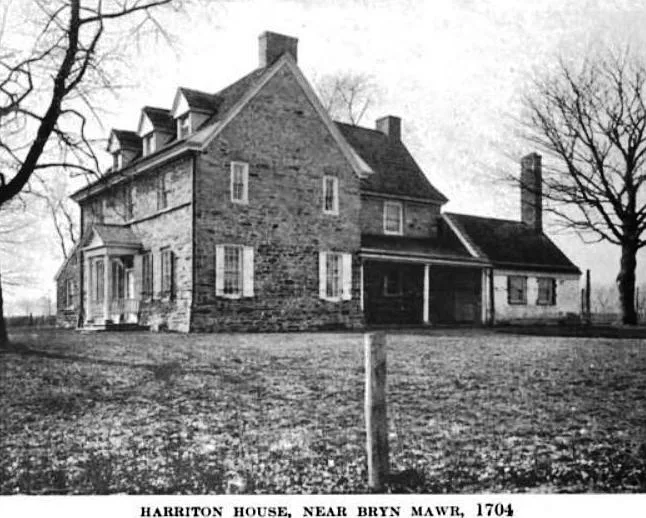

Why it's listed
Harriton is a fieldstone house in Bryn Mawr, Lower Merion Township, Pennsylvania, built in 1704 by Rowland Ellis, one of the leaders of the Welsh settlement in the Welsh Tract. Originally T-shaped, it reflects an uncommon Elizabethan plan, and its walls are laid in random coursed fieldstone. Richard Harrison bought the property in 1719, renamed it Harriton, and ran a tobacco plantation there for more than thirty years. His daughter Hannah married Charles Thomson in 1774, and Thomson, Secretary of the Continental Congress, lived at Harriton from 1789 until his death in 1824. He attested the Declaration of Independence as Secretary, co-designed the Seal of the United States, and produced a translation of the Bible from the Septuagint, which is regarded as the first such translation into English made in North America. The second-floor woodwork retains early 18th-century features, and the house is listed for its architecture and its association with Thomson.
Significance in brief: The house is significant for its early 18th-century origins and its association with Charles Thomson, Secretary of the Continental Congress, who lived there until his death in 1824. The nomination also argues that Thomson's translation of the Bible from the Septuagint, made in the Pennsylvania countryside, is a notable scholarly achievement. The surviving original fabric, including the second-floor woodwork, is cited as unusually well preserved.
Machine-generated summary. This summary was generated by a language model from the official nomination document and has not been reviewed line by line by an editor. It may contain errors. Check the source document before relying on any detail. Source: nomination document (PDF) · National Archives catalog entry. NRHP reference 73001643, listed July 2, 1973. Summary generated October 2026 (model claude-haiku-5-5, prompt v1.1-2026-10-29, confidence medium).
Key facts
| Address | 500 Harriton Rd., Bryn Mawr |
|---|---|
| County | Montgomery County |
| Listed | July 2, 1973 |
| Reference number | 73001643 |
| Resource type | Building |
| Period of significance | 1704-1824 |
| Architect / builder | Rowland Ellis (original builder of the 1704 house, as the statement of significance implies); Ralph L. Colton (architect of the 1926 alterations) |
| Criteria |
|
| Areas of significance | Literature, Science, Politics/Government, Religion, Agriculture |
| Level of significance | National |
| Status (as stated in the nomination) | Altered in 1926 and undergoing restoration by The Harriton Association, which is removing later work added by Colton; the property is owned by Lower Merion Township. |
| Acreage | 13.8 |
| Coordinates | 40.03495, -75.31100 (NPS GIS) |
What listing means for this property
National Register listing is honorary: it recognises significance and does not restrict what a private owner may do without federal money or permits. It unlocks the 20% federal rehabilitation tax credit for income-producing buildings, state credits in many states, and Section 106 review when federal agencies are involved. See what listing means in practice.
General information, not legal or tax advice. Rules change; confirm with your State Historic Preservation Office or a qualified adviser.
Sources and further reading
- National Park Service, National Register of Historic Places database (snapshot May 2026), reference 73001643.
- Nomination form (PDF, National Archives) — catalog entry
- Wikipedia article (used for cross-checking only; text not reproduced here)
- Wikidata Q5666321
- This listing as JSON
Last updated October 2026. Found an error? See the editorial policy for how to report it.