Dewalt Building

Why it's listed
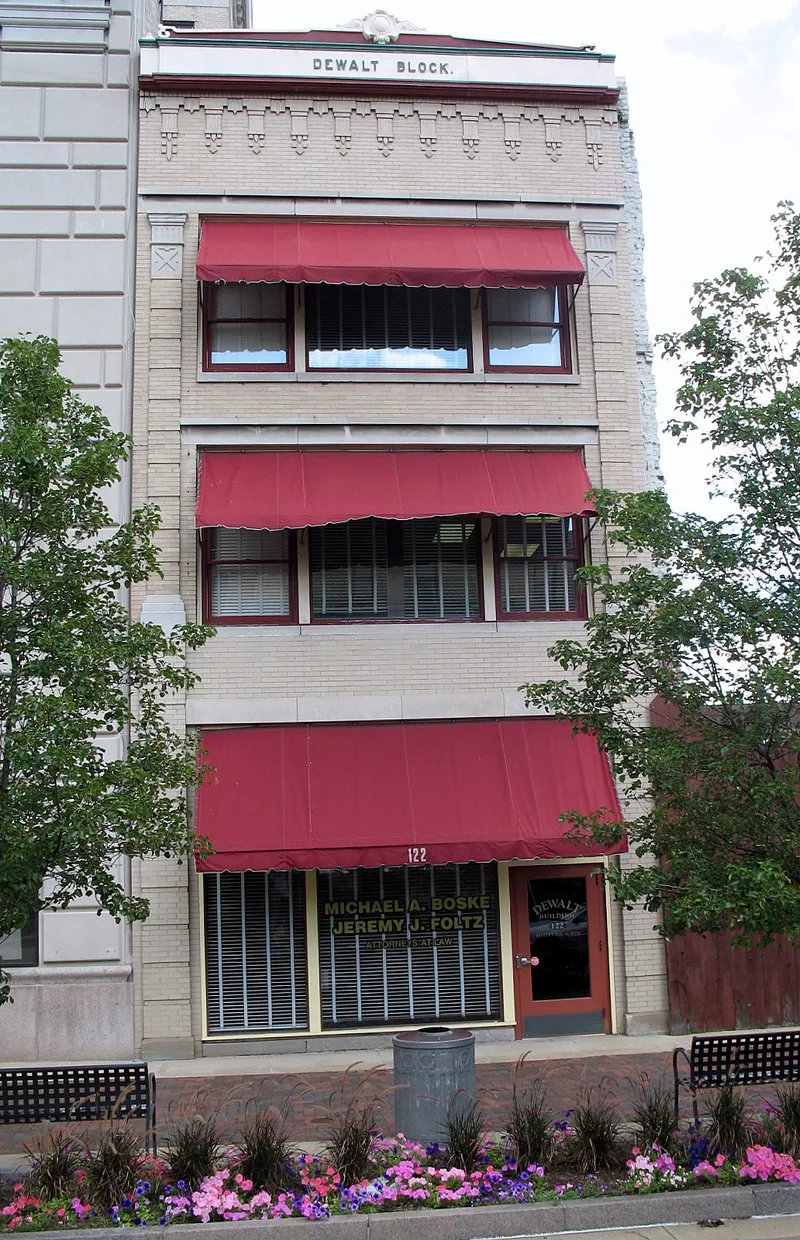
Standing at 122 Market Avenue North, this narrow three-story commercial block faces Canton's Central Plaza and the Stark County Courthouse. Its yellow brick facade has stone trim, a cornice with a central cartouche reading "Dewalt Block," and brick details that suggest brackets and fleurons. Stone drip moldings and lintels top the upper windows, and the ground-floor storefront was covered with temporary panels to deter vandalism. The site belonged to the Dewalt family from 1840. Earlier buildings stood there, including a commercial structure built about 1860, and the present facade dates from the 1920s, when a new neighboring bank prompted a facelift. Demolitions have left the Dewalt Building and the former Harter Bank as the only two early twentieth-century survivors on this side of the block. It is also a good local example of a commercial type with classical detail and wide tripartite windows influenced by Chicago-style design.
Significance in brief: It is one of only two buildings in its block, and one of four in the five-block area around Canton's public square, that retain the look of the city's late 19th and early 20th century commercial center. It is also tied to the Dewalt family, who owned the site from 1840. It represents a commercial building type with classical details and wide tripartite windows influenced by Chicago-style buildings.
Machine-generated summary. This summary was generated by a language model from the official nomination document and has not been reviewed line by line by an editor. It may contain errors. Check the source document before relying on any detail. Source: nomination document (PDF) · National Archives catalog entry. NRHP reference 82003645, listed July 15, 1982. Summary generated October 2026 (model claude-sonnet-5-5, prompt v1.0-2026-10-29, confidence medium).
Key facts
| Address | 122 Market Ave., N, Canton |
|---|---|
| County | Stark County |
| Listed | July 15, 1982 |
| Reference number | 82003645 |
| Resource type | Building |
| Period of significance | 1800-1899, 1900- |
| Architect / builder | Unknown |
| Architectural style | Late 19th and early 20th century commercial style, with classical details and Chicago-style influence |
| Criteria |
|
| Areas of significance | Commerce, Architecture |
| Level of significance | Local |
| Status (as stated in the nomination) | Described as deteriorated and altered, with the storefront covered by temporary panels to prevent vandalism; restoration of the street facade was reported as underway. |
| Acreage | 0.9 |
| Coordinates | 40.79923, -81.37490 (NPS GIS) |
What listing means for this property
For an income-producing building, listing (individually or as a contributing building in a district) is the gateway to the 20% federal rehabilitation tax credit on qualified rehabilitation costs, often stackable with state credits. Work claiming the credit must follow the Secretary of the Interior's Standards and be approved in advance.
Listing does not restrict a private owner acting without federal money or permits; where federal funding or licensing is involved, Section 106 review applies.
Noted as vacant in the nomination. Nomination documents can be decades old; current status may differ. If you are considering buying an empty listed property, read the due-diligence checklist.
General information, not legal or tax advice. Rules change; confirm with your State Historic Preservation Office or a qualified adviser.
Sources and further reading
- National Park Service, National Register of Historic Places database (snapshot May 2026), reference 82003645.
- Nomination form (PDF, National Archives) — catalog entry
- Wikidata Q138684920
- This listing as JSON
Last updated October 2026. Found an error? See the editorial policy for how to report it.