Smith, Edwin, House
Also known as: Dayton Bicycle Club; Craighead House

Why it's listed
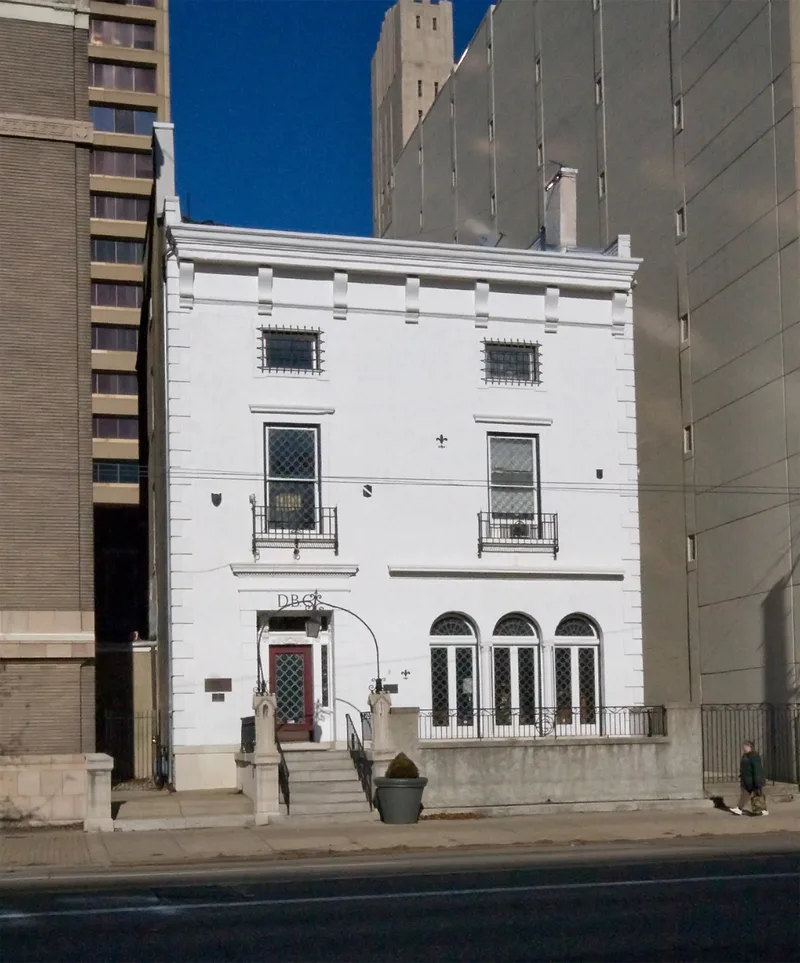
Built in 1850 for Dr. Edwin Smith, this three-story brick townhouse at 131 West Third Street in Dayton is an example of Renaissance revival design in the Tuscan mode. Its exterior has been changed over time, with stucco, iron balcony railings and arched first-floor doors added in 1925, but the interior remains largely intact, including a three-story circular staircase in the vestibule. Smith was a Democratic state legislator and the first president of the Montgomery County Medical Society. Senator Stephen A. Douglas stayed here in September 1859. Lawyer Samuel Craighead bought the house in 1872. The Dayton Bicycle Club, founded in 1884, has occupied it since 1915 and kept its interior features. The club took part in the push for Dayton's city manager charter. The house is one of few early urban dwellings left in the city, and at the time of listing a proposed parking garage extension threatened it.
Significance in brief: The house is tied to Dr. Edwin Smith, a Democratic legislator and first president of the Montgomery County Medical Society, and to lawyer Samuel Craighead. It hosted Senator Stephen A. Douglas in 1859. It is one of few early urban dwellings left in Dayton and has a notable circular staircase and a rare bridged chimney profile. The Dayton Bicycle Club, which has occupied it since 1915, played a role in adopting the city manager charter.
Machine-generated summary. This summary was generated by a language model from the official nomination document and has not been reviewed line by line by an editor. It may contain errors. Check the source document before relying on any detail. Source: nomination document (PDF) · National Archives catalog entry. NRHP reference 74001582, listed August 13, 1974. Summary generated October 2026 (model claude-sonnet-5-5, prompt v1.0-2026-10-29, confidence high).
Key facts
| Address | 131 W. 3rd St., Dayton |
|---|---|
| County | Montgomery County |
| Listed | August 13, 1974 |
| Reference number | 74001582 |
| Resource type | Building |
| Period of significance | 1850-1852 |
| Architectural style | Renaissance revival townhouse in the Tuscan mode |
| Areas of significance | Architecture |
| Level of significance | Local |
| Status (as stated in the nomination) | Occupied as a private club; interior in excellent condition and largely unaltered, exterior altered. The form says it is threatened by a proposed parking garage extension that could require razing it. |
| Acreage | 0.9 |
| Within district | Downtown Dayton Historic District |
| Coordinates | 39.75912, -84.19491 (NPS GIS) |
What listing means for this property
National Register listing is honorary for a privately owned home: it does not by itself restrict what an owner may do with their own money, and it does not require public access. Restrictions come from local landmark or historic-district ordinances, which are separate (how they differ).
Owner-occupied houses are not eligible for the 20% federal rehabilitation tax credit, which applies to income-producing buildings, but many states offer credits for homeowners. Listing also opens the door to preservation easements and to buying a plaque. Start with what listing means for homeowners, renovating a listed house and selling one.
General information, not legal or tax advice. Rules change; confirm with your State Historic Preservation Office or a qualified adviser.
Sources and further reading
- National Park Service, National Register of Historic Places database (snapshot May 2026), reference 74001582.
- Nomination form (PDF, National Archives) — catalog entry
- Wikipedia article (used for cross-checking only; text not reproduced here)
- Wikidata Q5346829
- This listing as JSON
Last updated October 2026. Found an error? See the editorial policy for how to report it.