Cox, George B., House
Also known as: Parkview; Pi Kappa Alpha Fraternity House

Why it's listed
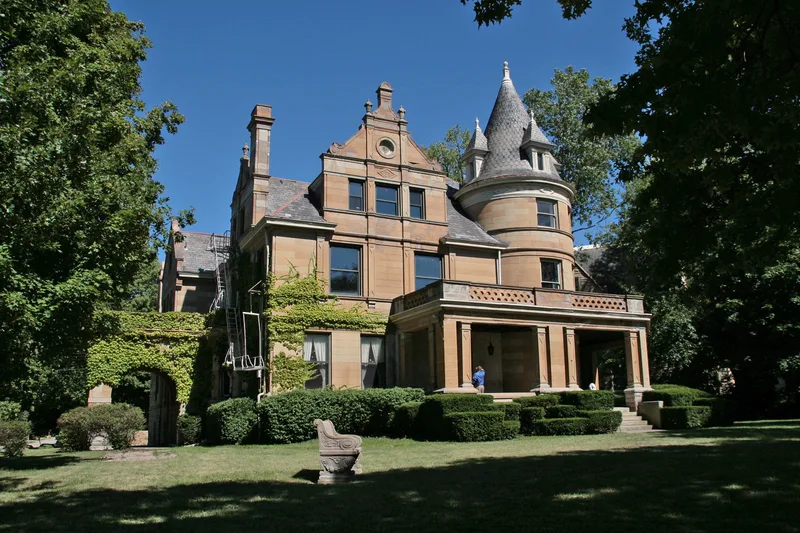
Built in 1894 at Brookline and Jefferson Avenues in Cincinnati's Clifton area, this sandstone residence was home to George B. Cox, the political boss who dominated the city's Republican machine. The house rises 2½ stories above a rock-faced stone foundation, with a 3½-story circular tower, slate roof, curved wraparound porch, and a porte-cochère with a large stained glass window above it. Inside, a hand-carved staircase, tiled fireplaces, mirrors and built-in carved furniture survive. A state inventory names Samuel Hannaford and Sons as designers and describes the style as Chateauesque. Cox began work as a boy, won a City Council seat in 1877, and built a political organization that held power until after his death in 1916. He also controlled the World Film Corporation. Mrs. Cox lived in the house until 1943, and a Catholic agency later used it as a home for unwed mothers. The Pi Kappa Alpha Fraternity has owned it since 1947. The house also marks the entrance to a historic Clifton neighborhood.
Significance in brief: The nomination ties the house to George B. Cox (1853-1916), the Republican political "Boss" of Cincinnati, and notes his business interests, including control of the World Film Corporation. It is also cited for its architecture and as a visual gateway to an historically important Clifton neighborhood.
Machine-generated summary. This summary was generated by a language model from the official nomination document and has not been reviewed line by line by an editor. It may contain errors. Check the source document before relying on any detail. Source: nomination document (PDF) · National Archives catalog entry. NRHP reference 73001456, listed November 6, 1973. Summary generated October 2026 (model claude-sonnet-5-5, prompt v1.0-2026-10-29, confidence high).
Key facts
| Address | Brookline and Jefferson Aves., Cincinnati |
|---|---|
| County | Hamilton County |
| Listed | November 6, 1973 |
| Reference number | 73001456 |
| Resource type | Building |
| Period of significance | 1894 |
| Architect / builder | Samuel Hannaford and Sons (architect); builder unknown |
| Architectural style | Chateauesque |
| Areas of significance | Politics/Government, Architecture |
| Level of significance | Local |
| Status (as stated in the nomination) | Used since 1947 as a meeting house and residence by the Pi Kappa Alpha Fraternity; condition listed as fair on the nomination form and good on the later state inventory. |
| Acreage | 0.9 |
| Coordinates | 39.14254, -84.51503 (NPS GIS) |
What listing means for this property
National Register listing is honorary for a privately owned home: it does not by itself restrict what an owner may do with their own money, and it does not require public access. Restrictions come from local landmark or historic-district ordinances, which are separate (how they differ).
Owner-occupied houses are not eligible for the 20% federal rehabilitation tax credit, which applies to income-producing buildings, but many states offer credits for homeowners. Listing also opens the door to preservation easements and to buying a plaque. Start with what listing means for homeowners, renovating a listed house and selling one.
General information, not legal or tax advice. Rules change; confirm with your State Historic Preservation Office or a qualified adviser.
Sources and further reading
- National Park Service, National Register of Historic Places database (snapshot May 2026), reference 73001456.
- Nomination form (PDF, National Archives) — catalog entry
- Wikipedia article (used for cross-checking only; text not reproduced here)
- Wikidata Q5536540
- This listing as JSON
Last updated October 2026. Found an error? See the editorial policy for how to report it.