J.C. Price High School
Also known as: Joseph Charles Price High School
J.C. Price High School is a building in Salisbury, Rowan County, North Carolina, listed on the National Register of Historic Places on April 21, 2010 (reference number 10000208). The National Park Service records its significance in Architecture, Education and Black at the local level.
Facts from the NPS National Register database (); nomination summary October 2026. Last updated . Sources for each fact.

Approximate location: the National Park Service places this pin arbitrarily within the property, not at a surveyed point (stated accuracy ±12 m).
Why it's listed
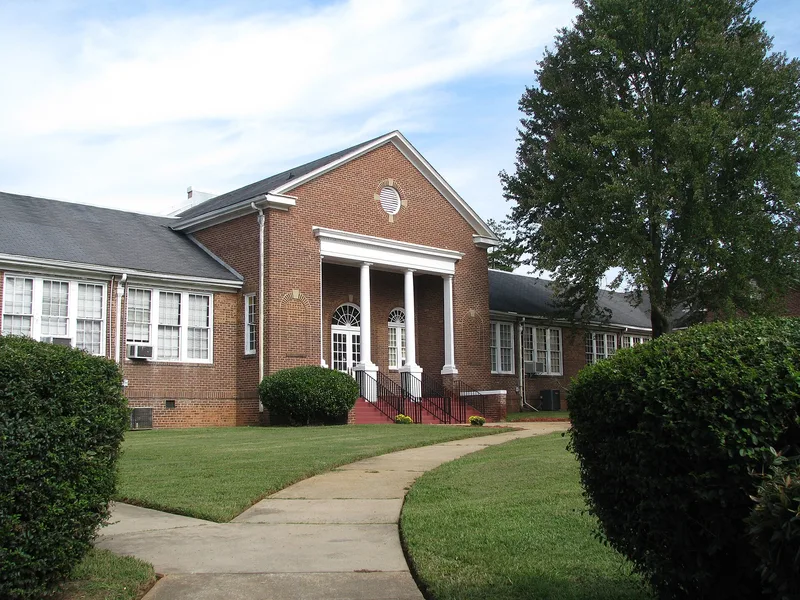
Built in 1931 on West Bank Street in west central Salisbury, the one-story brick school follows a symmetrical H-shaped Colonial Revival plan designed by Barbee and Yoe. Builder Jack William Long completed it that year, and it opened as the city's black high school in January 1932. Funding came partly from a Julius Rosenwald Fund grant of $5,300, which was the largest such grant in North Carolina that year. The school is regarded as the first public school in Salisbury erected exclusively for black high school students. Principal Louico Hamilton Hall, who led black public education in the city from 1911, oversaw the school from 1932 to 1947. Its 1951 gymnasium and 1956-1957 classroom and cafeteria buildings were positioned to complement the original block. The school served Salisbury's black students until integration at the start of the 1969-1970 school year, and its architecture retains much of its original character.
Significance in brief: The nomination argues the school is the first and only public school building in Salisbury erected exclusively as a high school for black students, and that it is closely tied to principal Louico Hamilton Hall, the Julius Rosenwald Fund's school-building support, and the Colonial Revival architectural design of its 1931 building. It is also presented as the focus of pride in the city's black community until integration in 1969.
Machine-generated summary. This summary was generated by a language model from the official nomination document and has not been reviewed line by line by an editor. It may contain errors. Check the source document before relying on any detail. Source: nomination document (PDF) · National Archives catalog entry. NRHP reference 10000208, listed April 21, 2010. Summary generated October 2026 (model claude-haiku-5-5, prompt v1.1-2026-10-29, confidence medium).
Key facts
| Official database NPS National Register database, ref. 10000208 , checked | |
|---|---|
| Address | 1300-1400 W. Bank St., Salisbury |
| County | Rowan County |
| Listed | April 21, 2010 |
| Reference number | 10000208 |
| Resource type | Building |
| Areas of significance | Architecture, Education, Black |
| Level of significance | Local |
| National Historic Landmark | No |
| Acreage | 9.5 |
| Official document, machine-extracted Nomination form (National Archives) , checked | |
| Period of significance | 1931-1969 |
| Architect / builder | Barbee and Yoe (architects); Jack William Long (builder); John Richard Hartlege Jr. (architect, 1951 gymnasium); John Erwin Ramsay (architect, 1956-1957 buildings) |
| Architectural style | Colonial Revival |
| Criteria |
|
| Status (as stated in the nomination) | All four buildings are in use for educational, social, or recreational uses and in fair to good condition. |
| Official dataset NPS cultural-resource GIS (NRHP locations) | |
| Coordinates | 35.67713, -80.49567 |
What listing means for this property
For a publicly owned building or structure, listing mainly matters when federal funds, permits or licences are involved: projects then go through Section 106 review so effects on the property are considered. Listing also strengthens applications for preservation grants and, for leased income-producing uses, can enable the federal rehabilitation tax credit.
General information, not legal or tax advice. Rules change; confirm with your State Historic Preservation Office or a qualified adviser.
Questions about J.C. Price High School
When was J.C. Price High School added to the National Register of Historic Places?
J.C. Price High School was listed on April 21, 2010. Its National Register reference number is 10000208.
Is J.C. Price High School a National Historic Landmark?
No. The National Park Service database (snapshot of May 2026) lists J.C. Price High School on the National Register but does not record it as a National Historic Landmark.
Where is J.C. Price High School?
1300-1400 W. Bank St., Salisbury, Rowan County, North Carolina; coordinates 35.67713, -80.49567.
Why is J.C. Price High School historically significant?
According to a machine-generated summary of its nomination form: The nomination argues the school is the first and only public school building in Salisbury erected exclusively as a high school for black students, and that it is closely tied to principal Louico Hamilton Hall, the Julius Rosenwald Fund's school-building support, and the Colonial Revival architectural design of its 1931 building. It is also presented as the focus of pride in the city's black community until integration in 1969. Check the nomination document before relying on any detail.
Who designed or built J.C. Price High School?
The nomination form names Barbee and Yoe (architects); Jack William Long (builder); John Richard Hartlege Jr. (architect, 1951 gymnasium); John Erwin Ramsay (architect, 1956-1957 buildings) as architect or builder (extracted by machine from the nomination; check the source document).
Where can I read the original nomination for J.C. Price High School?
The nomination form is a public record held by the National Archives: nomination document (PDF).
Sources and further reading
- National Park Service, National Register of Historic Places database (snapshot May 2026), reference 10000208.
- Nomination form (PDF, National Archives) — catalog entry
- Wikipedia article (used for cross-checking only; text not reproduced here)
- Wikidata Q19987675
- This listing as JSON
Last updated November 2026. Found an error? See the editorial policy for how to report it.