Livingstone College Historic District (Additional Documentation)

Why it's listed
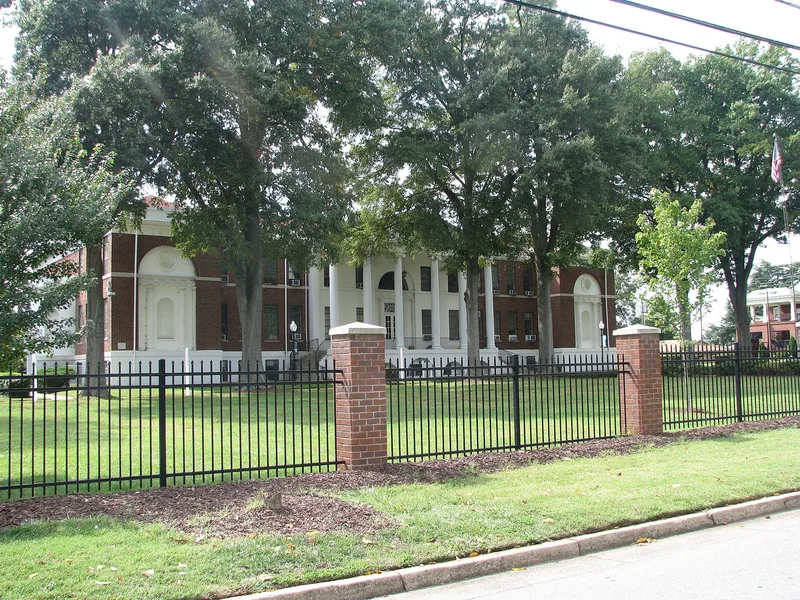
Livingstone College and its adjoining residential street occupy a hilltop in Salisbury, North Carolina, where the school moved in 1882 from Concord. The campus is laid out around a wide lawn lined with oaks, with brick buildings spaced apart and Goler Hall at the center. The college was founded by the A.M.E. Zion Church after earlier attempts failed, and it was one of the few black schools in the South established and run by a black church. Its first president, Joseph Charles Price, raised funds in England, and the school grew through teacher training, industrial trades and theological courses. Dodge Hall (1886), Ballard Hall (1887), Carnegie Library (1908), the Hood Building (1910) and Goler Hall (1917) remain from this early period. Modest Victorian homes on West Monroe Street were built for faculty and college leaders, including the Price and Dancy houses. The district is significant for its link to black education and for its surviving campus and housing from the late nineteenth and early twentieth centuries.
Significance in brief: The nomination argues the district is important for black higher education, as a college founded and operated by a black church, the A.M.E. Zion Church, at a time when most black schools were run by white institutions. It also links the college to nationally known black leaders such as Joseph Charles Price, William Henry Goler and James E. K. Aggrey, and describes the campus and neighborhood as a nearly intact late 19th and early 20th century black college community.
Machine-generated summary. This summary was generated by a language model from the official nomination document and has not been reviewed line by line by an editor. It may contain errors. Check the source document before relying on any detail. Source: nomination document (PDF) · National Archives catalog entry. NRHP reference 82003509, listed May 27, 1982. Summary generated October 2026 (model claude-haiku-5-5, prompt v1.1-2026-10-29, confidence medium).
Key facts
| Address | W. Monroe St., Salisbury |
|---|---|
| County | Rowan County |
| Listed | May 27, 1982 |
| Reference number | 82003509 |
| Resource type | District |
| Period of significance | 1850-1899 |
| Architectural style | Victorian eclectic, primarily of a vaguely classical bent |
| Criteria |
|
| Areas of significance | Education, Architecture, Religion, Social History, Ethnic Heritage-Black |
| Level of significance | State, Local |
| Status (as stated in the nomination) | Several buildings survive; the document notes that a few homes have been lost since 1930 and the older campus has been ringed with newer construction. |
| Acreage | 23 |
| Coordinates | 35.67090, -80.48379 (NPS GIS) |
What listing means for this property
This is a historic district. Buildings within its boundary are either contributing (they add to the district's significance) or non-contributing. Owners of contributing income-producing buildings can claim the 20% federal rehabilitation tax credit; homeowners should look at state credits. National Register districts impose no design review by themselves; a local historic district ordinance, if one exists, does (the difference explained).
General information, not legal or tax advice. Rules change; confirm with your State Historic Preservation Office or a qualified adviser.
Sources and further reading
- National Park Service, National Register of Historic Places database (snapshot May 2026), reference 82003509.
- Nomination form (PDF, National Archives) — catalog entry
- Wikipedia article (used for cross-checking only; text not reproduced here)
- Wikidata Q6659715
- This listing as JSON
Last updated October 2026. Found an error? See the editorial policy for how to report it.