Hopkins Farm

Why it's listed
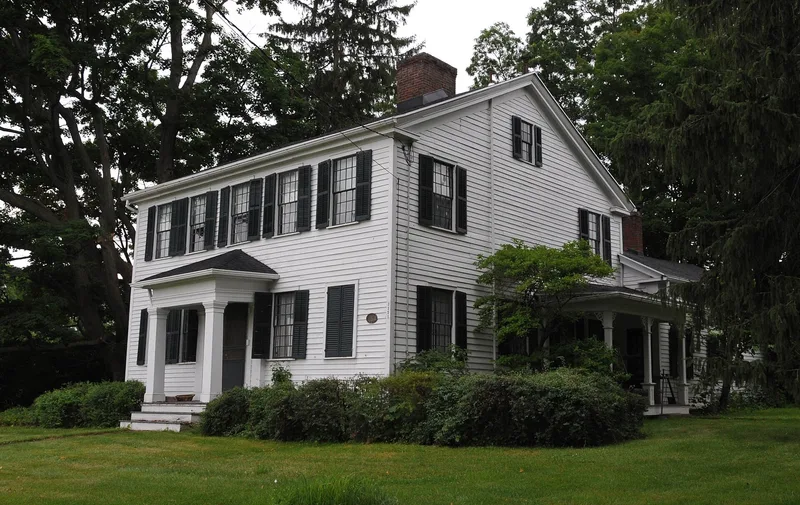
Hopkins Farm covers 370 acres two miles southwest of the village of Pittsford, on both sides of Clover Street. The land has remained with the Hopkins family since Caleb Hopkins, a military officer, customs official and early Rochester-area businessman, bought it in the early nineteenth century. The core is the original 164-acre homestead, joined in the early twentieth century by the Barker farm and part of the Nye farm. The centerpiece is a circa 1815 hewn-timber farmhouse with a central chimney, Federal interior details and Greek Revival additions from about 1850. Around it are barns, a smokehouse, corn crib, windmill derrick, outhouse and tenant houses, built from the early 1800s through the 1900s. A circa 1912 dairy barn and a former English barn show how farming changed over time. A 29-acre old-growth wood lot and open fields preserve the traditional farm layout, even as suburban housing now surrounds the property.
Significance in brief: The farm has stayed in the Hopkins family since Caleb Hopkins bought land there, and it keeps buildings and land use from across the nineteenth and twentieth centuries. The farmhouse is one of Pittsford's oldest surviving framed houses and retains unusually high integrity. The 29-acre old-growth wood lot is described as a rare surviving example of a typical early farm layout.
Machine-generated summary. This summary was generated by a language model from the official nomination document and has not been reviewed line by line by an editor. It may contain errors. Check the source document before relying on any detail. Source: nomination document (PDF) · National Archives catalog entry. NRHP reference 00001153, listed October 6, 2000. Summary generated October 2026 (model claude-sonnet-5-5, prompt v1.0-2026-10-29, confidence medium).
Key facts
| Address | 3151 Clover St., Pittsford |
|---|---|
| County | Monroe County |
| Listed | October 6, 2000 |
| Reference number | 00001153 |
| Resource type | District |
| Architectural style | Early Republic/Federal; Mid-19th Century/Greek Revival |
| Areas of significance | Agriculture, Architecture, Exploration/Settlement |
| Level of significance | Local |
| Status (as stated in the nomination) | Current functions listed as single dwelling and agricultural use; the farm is still operating and surrounded by suburban development. |
| Acreage | 370 |
| Coordinates | 43.06392, -77.55496 (NPS GIS) |
What listing means for this property
This is a historic district. Buildings within its boundary are either contributing (they add to the district's significance) or non-contributing. Owners of contributing income-producing buildings can claim the 20% federal rehabilitation tax credit; homeowners should look at state credits. National Register districts impose no design review by themselves; a local historic district ordinance, if one exists, does (the difference explained).
General information, not legal or tax advice. Rules change; confirm with your State Historic Preservation Office or a qualified adviser.
Sources and further reading
- National Park Service, National Register of Historic Places database (snapshot May 2026), reference 00001153.
- Nomination form (PDF, National Archives) — catalog entry
- Wikipedia article (used for cross-checking only; text not reproduced here)
- Wikidata Q5900661
- This listing as JSON
Last updated October 2026. Found an error? See the editorial policy for how to report it.