Blackwell, Antoinette Louisa Brown, Childhood Home

Why it's listed
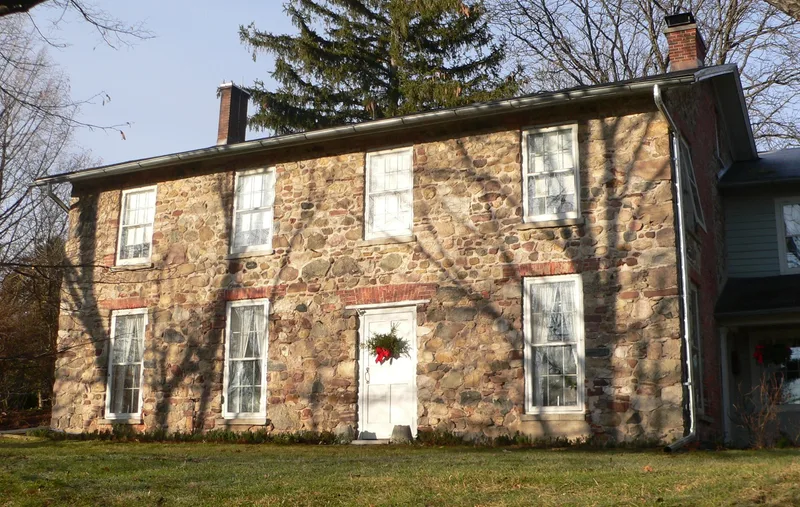
This farmhouse at 1099 Pinnacle Road in Henrietta, New York, was built in 1830 by Joseph Brown, a wheat farmer who settled in the town in 1819. Its main block is coursed fieldstone with brick infill, originally covered in stucco scored to resemble cut stone, and wings extend to the north. Stucco survives on the rear wall. Inside, original trim, doors, window glass, plaster, fireplaces and rough-hewn attic framing remain. The house was the childhood home of Antoinette Louisa Brown Blackwell, born in 1825, who became a women's rights activist and the first ordained female minister in the United States. Her family took part in the religious revivals of the burned-over district, which shaped her views on religion and women's rights. The significant period ends about 1840, when she finished at Monroe Academy. The house is also valued as a rare example of early stone and stucco building in a suburb that has otherwise been heavily developed.
Significance in brief: It is the childhood home of Antoinette Louisa Brown Blackwell, a women's rights activist and the first ordained female minister in the United States. It is linked to her formative years amid evangelical revivals in western New York. It is also a rare, largely intact example of early nineteenth century stone and stucco vernacular construction in Henrietta.
Machine-generated summary. This summary was generated by a language model from the official nomination document and has not been reviewed line by line by an editor. It may contain errors. Check the source document before relying on any detail. Source: nomination document (PDF) · National Archives catalog entry. NRHP reference 89002003, listed November 16, 1989. Summary generated October 2026 (model claude-sonnet-5-5, prompt v1.0-2026-10-29, confidence high).
Key facts
| Address | 1099 Pinnacle Rd., Henrietta |
|---|---|
| County | Monroe County |
| Listed | November 16, 1989 |
| Reference number | 89002003 |
| Resource type | Building |
| Period of significance | ca. 1830 - ca. 1840 |
| Architectural style | Federal |
| Criteria |
|
| Areas of significance | Architecture, Social History |
| Level of significance | Local |
| Status (as stated in the nomination) | Continues in use as a single-family dwelling; the form notes some modifications, including early 1980s and 1988 remodeling of wings and interiors. |
| Acreage | 11 |
| Coordinates | 43.05158, -77.59942 (NPS GIS) |
What listing means for this property
National Register listing is honorary for a privately owned home: it does not by itself restrict what an owner may do with their own money, and it does not require public access. Restrictions come from local landmark or historic-district ordinances, which are separate (how they differ).
Owner-occupied houses are not eligible for the 20% federal rehabilitation tax credit, which applies to income-producing buildings, but many states offer credits for homeowners. Listing also opens the door to preservation easements and to buying a plaque. Start with what listing means for homeowners, renovating a listed house and selling one.
General information, not legal or tax advice. Rules change; confirm with your State Historic Preservation Office or a qualified adviser.
Sources and further reading
- National Park Service, National Register of Historic Places database (snapshot May 2026), reference 89002003.
- Nomination form (PDF, National Archives) — catalog entry
- Wikipedia article (used for cross-checking only; text not reproduced here)
- Wikidata Q4775589
- This listing as JSON
Last updated October 2026. Found an error? See the editorial policy for how to report it.