Delano, Clayton H., House

Why it's listed
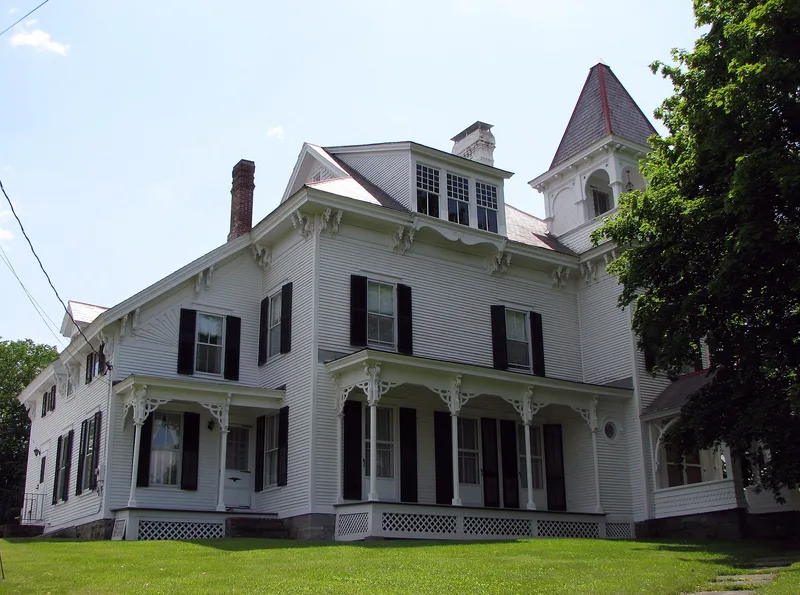
Standing on a slight knoll at the corner of Lake George Avenue and Father Jogues Place in Ticonderoga, this clapboard and slate-roofed house began in 1857 as an Italianate residence for Joel Holcomb. Clayton H. Delano, who lived there by 1877 and whose wife Annie bought the property in 1878, enlarged it around 1890 with a southern section, a three-story corner tower, porches and stained-glass dormers. The result is a picturesque Queen Anne building with scroll-sawn ornament, sunflower and sunburst motifs, and Eastlake porches. The interior survives largely intact, including a paneled living room, carved L-shaped staircase and terra-cotta fireplace. A carriage barn from 1877 also remains. Delano founded the Ticonderoga Pulp and Paper Company in 1877, an enterprise that grew into a national leader in wood pulp and fine paper. The house is considered one of the village's finest residences and reflects the wealth of its industrialist owner.
Significance in brief: The house is a distinctive and highly ornate local example of Queen Anne architecture, with Eastlake influences and a remarkably intact interior. It is also tied to Clayton H. Delano, founder of the Ticonderoga Pulp and Paper Company, which became the community's most important economic force and the region's largest employer.
Machine-generated summary. This summary was generated by a language model from the official nomination document and has not been reviewed line by line by an editor. It may contain errors. Check the source document before relying on any detail. Source: nomination document (PDF) · National Archives catalog entry. NRHP reference 88002195, listed November 15, 1988. Summary generated October 2026 (model claude-sonnet-5-5, prompt v1.0-2026-10-29, confidence medium).
Key facts
| Address | 25 Father Jogues Pl., Ticonderoga |
|---|---|
| County | Essex County |
| Listed | November 15, 1988 |
| Reference number | 88002195 |
| Resource type | Building |
| Architectural style | Queen Anne (originally Italianate, with Eastlake influences) |
| Areas of significance | Industry, Architecture |
| Level of significance | Local |
| Status (as stated in the nomination) | Described as in excellent condition, in use as a private residence, with no known threats. |
| Acreage | 0.9 |
| Coordinates | 43.84718, -73.42652 (NPS GIS) |
What listing means for this property
National Register listing is honorary for a privately owned home: it does not by itself restrict what an owner may do with their own money, and it does not require public access. Restrictions come from local landmark or historic-district ordinances, which are separate (how they differ).
Owner-occupied houses are not eligible for the 20% federal rehabilitation tax credit, which applies to income-producing buildings, but many states offer credits for homeowners. Listing also opens the door to preservation easements and to buying a plaque. Start with what listing means for homeowners, renovating a listed house and selling one.
General information, not legal or tax advice. Rules change; confirm with your State Historic Preservation Office or a qualified adviser.
Sources and further reading
- National Park Service, National Register of Historic Places database (snapshot May 2026), reference 88002195.
- Nomination form (PDF, National Archives) — catalog entry
- Wikipedia article (used for cross-checking only; text not reproduced here)
- Wikidata Q5130229
- This listing as JSON
Last updated October 2026. Found an error? See the editorial policy for how to report it.