Hale, Edward Everett, House

Why it's listed
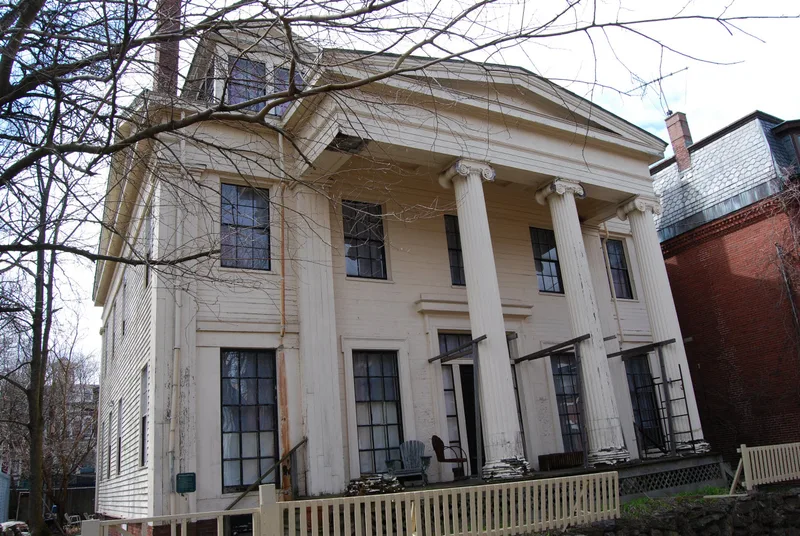
This two-story frame house at 12 Morley Street in Roxbury, Boston, is a large Greek Revival residence with a gable roof, a three-bay Ionic portico, pedimented dormers and paired chimneys. Probably built in 1841 by carpenter Benjamin Kent, it first stood on Highland Street, a street laid out in 1825 to create a pleasant residential community. Between 1899 and 1906 it was moved around the corner to its present site. Inside, a wide center hall divides the principal rooms, and original marble mantels survive. The house is noted both as an elaborate example of a style often used for suburban homes and for its association with Edward Everett Hale, who lived there from 1869 until his death in 1909. Hale was a Unitarian minister, reformer and writer whose 1863 story "The Man Without a Country" became his best-known work. He also served as chaplain of the U.S. Senate from 1903 to 1909. The house is altered and deteriorated but retains much historic character.
Significance in brief: The nomination calls it an outstanding example of a large frame Greek Revival residence, built as a rural Roxbury neighborhood grew into a dense suburb. It is also notable as the home from 1869 to 1909 of Edward Everett Hale, a Unitarian clergyman, humanitarian reformer and author of "The Man Without a Country."
Machine-generated summary. This summary was generated by a language model from the official nomination document and has not been reviewed line by line by an editor. It may contain errors. Check the source document before relying on any detail. Source: nomination document (PDF) · National Archives catalog entry. NRHP reference 73000325, listed March 21, 1979. Summary generated October 2026 (model claude-sonnet-5-5, prompt v1.0-2026-10-29, confidence high).
Key facts
| Address | 12 Morley St., Boston |
|---|---|
| County | Suffolk County |
| Listed | March 21, 1979 |
| Reference number | 73000325 |
| Resource type | Building |
| Period of significance | 1841; Hale Home, 1869-1909 (19th Century) |
| Architect / builder | Benjamin Kent, carpenter (probable builder) |
| Architectural style | Greek Revival |
| Areas of significance | Literature, Architecture, Religion |
| Level of significance | National |
| Status (as stated in the nomination) | Listed as occupied and in use as a private residence, with condition checked as deteriorated and altered. The house was moved between 1899 and 1906 from Highland Street to Morley Street. Preservation work was noted as in progress. |
| Acreage | 0.9 |
| Within district | Roxbury Highlands Historic District |
| Coordinates | 42.32899, -71.09213 (NPS GIS) |
What listing means for this property
National Register listing is honorary for a privately owned home: it does not by itself restrict what an owner may do with their own money, and it does not require public access. Restrictions come from local landmark or historic-district ordinances, which are separate (how they differ).
Owner-occupied houses are not eligible for the 20% federal rehabilitation tax credit, which applies to income-producing buildings, but many states offer credits for homeowners. Listing also opens the door to preservation easements and to buying a plaque. Start with what listing means for homeowners, renovating a listed house and selling one.
General information, not legal or tax advice. Rules change; confirm with your State Historic Preservation Office or a qualified adviser.
Sources and further reading
- National Park Service, National Register of Historic Places database (snapshot May 2026), reference 73000325.
- Nomination form (PDF, National Archives) — catalog entry
- Wikipedia article (used for cross-checking only; text not reproduced here)
- Wikidata Q5342808
- This listing as JSON
Last updated October 2026. Found an error? See the editorial policy for how to report it.