Garrison, William Lloyd, House
Also known as: Rockledge; St. Monica's Home

Why it's listed
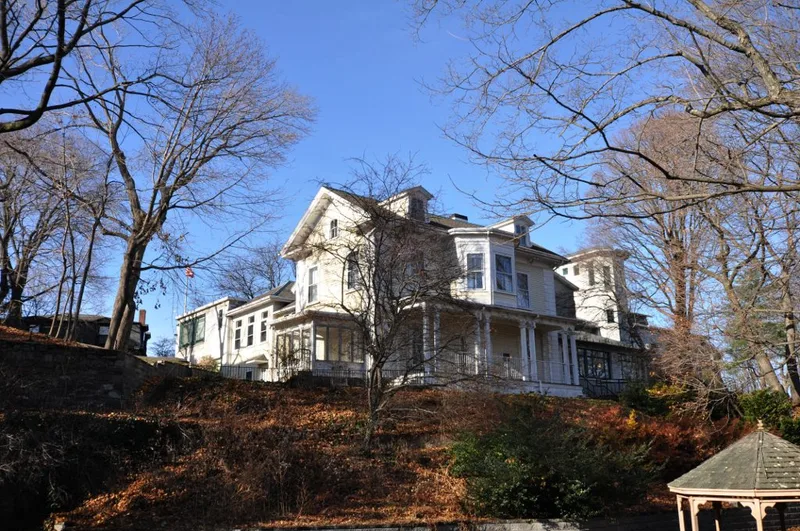
This frame house on a rock ledge above Highland Street in Roxbury, Boston, was the home of William Lloyd Garrison from 1864 until his death in 1879. Originally named "Rockledge," it dates from the mid-19th century and began as a typical upper-middle-class suburban residence with a 2-story main block, a wing, and an ell. Garrison, the founder of the Liberator in 1831, argued for immediate emancipation and spent his later years here campaigning for prohibition, women's rights, and justice for American Indians. A group of black men and women, the Rockledge Association, maintained the house for a time. In 1904 the Episcopal Sisters of the Society of St. Margaret acquired it, and it became St. Monica's Home, a nursing facility. Over time the quoins were removed, siding was added, and a mansard-roofed section and a brick addition were built, but the basic massing remains and enough original detail survives to suggest its 19th-century character.
Significance in brief: Garrison lived here from 1864 until his death in 1879. He was described as the most articulate and influential advocate of abolitionism in the United States, and he founded the Liberator newspaper in 1831. The house is significant for its association with him and his continuing reform work after the Civil War.
Machine-generated summary. This summary was generated by a language model from the official nomination document and has not been reviewed line by line by an editor. It may contain errors. Check the source document before relying on any detail. Source: nomination document (PDF) · National Archives catalog entry. NRHP reference 66000653, listed October 15, 1966. Summary generated October 2026 (model claude-sonnet-5-5, prompt v1.0-2026-10-29, confidence high).
Key facts
| Address | 125 Highland St., Boston |
|---|---|
| County | Suffolk County |
| Listed | October 15, 1966 |
| Reference number | 66000653 |
| Resource type | Building |
| Period of significance | 1864-1879 |
| Architect / builder | not known |
| Areas of significance | Social History |
| Level of significance | National |
| National Historic Landmark | Yes, designated June 23, 1965 |
| Status (as stated in the nomination) | Operated as St. Monica's Home, a nursing facility for needy elderly women, and not open to the public. The exterior and interior have been altered, and a brick addition was built in 1961-63. |
| Acreage | 0.7 |
| Within district | Roxbury Highlands Historic District |
| Coordinates | 42.32594, -71.09384 (NPS GIS) |
What listing means for this property
National Register listing is honorary for a privately owned home: it does not by itself restrict what an owner may do with their own money, and it does not require public access. Restrictions come from local landmark or historic-district ordinances, which are separate (how they differ).
Owner-occupied houses are not eligible for the 20% federal rehabilitation tax credit, which applies to income-producing buildings, but many states offer credits for homeowners. Listing also opens the door to preservation easements and to buying a plaque. Start with what listing means for homeowners, renovating a listed house and selling one.
General information, not legal or tax advice. Rules change; confirm with your State Historic Preservation Office or a qualified adviser.
Sources and further reading
- National Park Service, National Register of Historic Places database (snapshot May 2026), reference 66000653.
- Nomination form (PDF, National Archives) — catalog entry
- Wikipedia article (used for cross-checking only; text not reproduced here)
- Wikidata Q8014641
- This listing as JSON
Last updated October 2026. Found an error? See the editorial policy for how to report it.