John Eliot Square District

Why it's listed
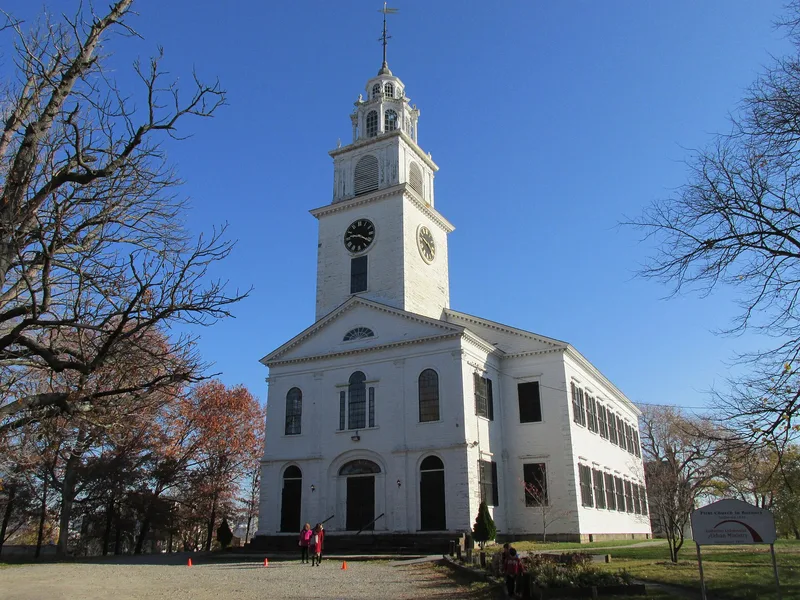
John Eliot Square District occupies about 9.5 acres at the fork of three streets in Roxbury, Boston. It groups buildings from the mid-1700s through the 1800s around a landscaped square. The centerpiece is the First Church in Roxbury, built in 1803-04 in the Federal meetinghouse style and described as the oldest frame church building in the city. The congregation has used the site since 1632. Nearby stand the Dillaway-Thomas House, built between 1750 and 1754 and possibly used by General John Thomas during the siege of Boston, and Ionic Hall, a Federal brick mansion. Later Victorian buildings include the Dudley School, the curved Cox Building of 1870, the Hotel Eliot of 1875, and the Marcus Garvey House, a former hotel later used as a settlement house. The square was the center of Roxbury from its founding in 1630, and the district preserves a varied mix of religious, civic, residential and commercial architecture.
Significance in brief: The square has been the center of Roxbury since the town's founding in 1630 and has been the site of the First Church since 1632. The district's buildings show a mixture of architectural styles and of residential, religious, civic and commercial uses. Key buildings include the 1804 First Church, the oldest frame church building in the city, and the Dillaway-Thomas House, linked to the siege of Boston.
Machine-generated summary. This summary was generated by a language model from the official nomination document and has not been reviewed line by line by an editor. It may contain errors. Check the source document before relying on any detail. Source: nomination document (PDF) · National Archives catalog entry. NRHP reference 73000854, listed April 23, 1973. Summary generated October 2026 (model claude-sonnet-5-5, prompt v1.0-2026-10-29, confidence medium).
Key facts
| Address | John Eliot Sq., Boston |
|---|---|
| County | Suffolk County |
| Listed | April 23, 1973 |
| Reference number | 73000854 |
| Resource type | District |
| Period of significance | c. 1750-1873 |
| Architect / builder | Timothy Palmer and William Blaney (conjectured, First Church); J. H. Besarick (Hotel Eliot); George Cox (Cox Building); Captain Stoddard of Hingham (Ionic Hall); Rev. Oliver Peabody (Dillaway-Thomas House) |
| Architectural style | Mixture of styles: Federal meetinghouse, Georgian, Federal, High Victorian Gothic |
| Areas of significance | Military, Architecture, Social History |
| Level of significance | State |
| Status (as stated in the nomination) | Buildings are in mixed use (residence, church, school, community services); the Dillaway-Thomas House lost its roof to a recent fire, and the form marks condition as ranging from excellent to deteriorated. |
| Acreage | 9.5 |
| Coordinates | 42.33423, -71.09594 (NPS GIS) |
What listing means for this property
This is a historic district. Buildings within its boundary are either contributing (they add to the district's significance) or non-contributing. Owners of contributing income-producing buildings can claim the 20% federal rehabilitation tax credit; homeowners should look at state credits. National Register districts impose no design review by themselves; a local historic district ordinance, if one exists, does (the difference explained).
General information, not legal or tax advice. Rules change; confirm with your State Historic Preservation Office or a qualified adviser.
Sources and further reading
- National Park Service, National Register of Historic Places database (snapshot May 2026), reference 73000854.
- Nomination form (PDF, National Archives) — catalog entry
- Wikipedia article (used for cross-checking only; text not reproduced here)
- Wikidata Q6231586
- This listing as JSON
Last updated October 2026. Found an error? See the editorial policy for how to report it.