Gloucester City Hall
Also known as: Town Hall; City Hall
Gloucester City Hall is a building in Gloucester, Essex County, Massachusetts, listed on the National Register of Historic Places on May 8, 1973 (reference number 73000297). The National Park Service records its significance in Politics/Government and Architecture at the local level.
Facts from the NPS National Register database (); nomination summary October 2026. Last updated . Sources for each fact.

Approximate location: the National Park Service places this pin arbitrarily within the property, not at a surveyed point (stated accuracy ±12 m).
Why it's listed
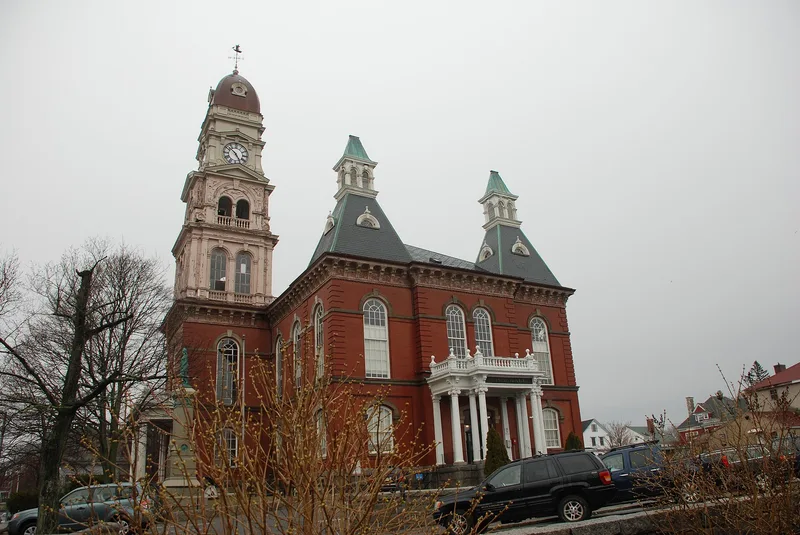
Gloucester City Hall is a red pressed-brick civic building on Dale Avenue, built in 1869-71 on one of the highest points in the city, overlooking the harbor. Gridley James Fox Bryant and Louis P. Rogers designed it, and it was dedicated on June 2, 1871, as the town's third seat of government. Its rectangular plan, corner pavilions and classical detail come from the French academic tradition, while bracketed cornices, quoins and arched windows reflect Italian Renaissance influence. A central clock tower rises in three tiers to a copper roof and is the highest man-made point in the city. Winslow Homer, Frank Duveneck and John Sloan painted views of the city centered on it. The original clock and bell were a gift from Samuel Sawyer. The grounds hold an 1879 Civil War monument, and murals by Charles Allen Winter from the late 1930s and early 1940s decorate the interior. The building remains well preserved and in use as city hall.
Significance in brief: The nomination calls it one of the most important buildings on Cape Ann physically, historically and architecturally. It is a well-preserved example of a dominant 19th-century civic monument, combining Italian Renaissance and French Second Empire elements, and it is the work of the prolific architect Bryant. Its tower is also a focal point of the city skyline and was painted by major American artists.
Machine-generated summary. This summary was generated by a language model from the official nomination document and has not been reviewed line by line by an editor. It may contain errors. Check the source document before relying on any detail. Source: nomination document (PDF) · National Archives catalog entry. NRHP reference 73000297, listed May 8, 1973. Summary generated October 2026 (model claude-sonnet-5-5, prompt v1.0-2026-10-29, confidence high).
Key facts
| Official database NPS National Register database, ref. 73000297 , checked | |
|---|---|
| Address | Dale Ave., Gloucester |
| County | Essex County |
| Listed | May 8, 1973 |
| Reference number | 73000297 |
| Resource type | Building |
| Areas of significance | Politics/Government, Architecture |
| Level of significance | Local |
| National Historic Landmark | No |
| Acreage | 9.9 |
| Official document, machine-extracted Nomination form (National Archives) , checked | |
| Period of significance | 1869-71 |
| Architect / builder | Gridley James Fox Bryant and Louis P. Rogers |
| Architectural style | Combination of Italian Renaissance and French Second Empire |
| Status (as stated in the nomination) | Described as well preserved and in excellent condition, in use as the seat of city government. The ornamental iron ridge crestings have been lost, and the interior has had some modernization. |
| Official dataset NPS cultural-resource GIS (NRHP locations) | |
| Coordinates | 42.61398, -70.66256 |
| Computed Computed from NPS GIS district boundaries | |
| Within district | Central Gloucester Historic District |
What listing means for this property
For a publicly owned building or structure, listing mainly matters when federal funds, permits or licences are involved: projects then go through Section 106 review so effects on the property are considered. Listing also strengthens applications for preservation grants and, for leased income-producing uses, can enable the federal rehabilitation tax credit.
General information, not legal or tax advice. Rules change; confirm with your State Historic Preservation Office or a qualified adviser.
Questions about Gloucester City Hall
When was Gloucester City Hall added to the National Register of Historic Places?
Gloucester City Hall was listed on May 8, 1973. Its National Register reference number is 73000297.
Is Gloucester City Hall a National Historic Landmark?
No. The National Park Service database (snapshot of May 2026) lists Gloucester City Hall on the National Register but does not record it as a National Historic Landmark.
Where is Gloucester City Hall?
Dale Ave., Gloucester, Essex County, Massachusetts; coordinates 42.61398, -70.66256.
Why is Gloucester City Hall historically significant?
According to a machine-generated summary of its nomination form: The nomination calls it one of the most important buildings on Cape Ann physically, historically and architecturally. It is a well-preserved example of a dominant 19th-century civic monument, combining Italian Renaissance and French Second Empire elements, and it is the work of the prolific architect Bryant. Its tower is also a focal point of the city skyline and was painted by major American artists. Check the nomination document before relying on any detail.
Who designed or built Gloucester City Hall?
The nomination form names Gridley James Fox Bryant and Louis P. Rogers as architect or builder (extracted by machine from the nomination; check the source document).
Is Gloucester City Hall in a historic district?
Yes. Its location falls within the Central Gloucester Historic District, itself listed on the National Register. (Computed from National Park Service boundary data; the district nomination's own list of contributing resources may differ.)
Where can I read the original nomination for Gloucester City Hall?
The nomination form is a public record held by the National Archives: nomination document (PDF).
Sources and further reading
- National Park Service, National Register of Historic Places database (snapshot May 2026), reference 73000297.
- Nomination form (PDF, National Archives) — catalog entry
- Wikipedia article (used for cross-checking only; text not reproduced here)
- Wikidata Q5572020
- This listing as JSON
Last updated November 2026. Found an error? See the editorial policy for how to report it.