Puritan House
Also known as: Tappan's Hotel; Atlantic House; Gloucester House; Mason's House

Why it's listed
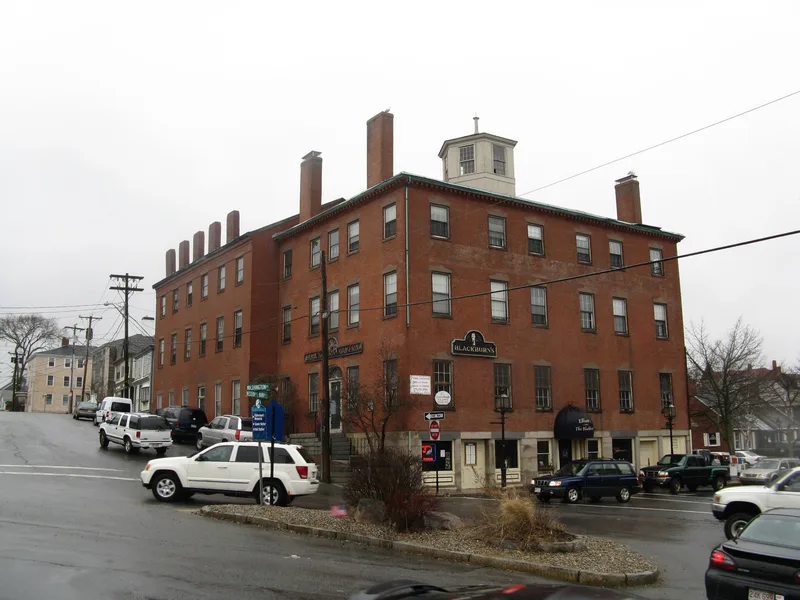
Built in 1810 at the corner of Main and Washington Streets in Gloucester, this brick hotel looks out over the inner harbor. Colonel James Tappan of New Hampshire, a former schoolteacher, built it and had to borrow money after workers hit solid ledge while digging the foundation. The main block rises four stories on a tall granite foundation, with a hip roof, dentils at the eaves and arched entrances. A three-story rear section from the same year runs up Washington Street, and a wooden addition followed around 1905. Inside, a winding staircase rises from the lobby, and many of the forty-five guest rooms keep original molding, wainscoting and carved mantels. When built, it was among the first brick buildings in the village and its first hotel, and it hosted much of the town's social life through the nineteenth century. It survived the 1830 fire, and the painter Winslow Homer stayed there in 1873. At the time of listing it stood vacant while rehabilitation was under way.
Significance in brief: It was one of the first brick buildings in Gloucester and the town's first hotel. With forty-five guest rooms it was unusually large for a small fishing village, and it served as a community focus for social functions through the nineteenth century. It was also one of the few buildings to survive the 1830 fire.
Machine-generated summary. This summary was generated by a language model from the official nomination document and has not been reviewed line by line by an editor. It may contain errors. Check the source document before relying on any detail. Source: nomination document (PDF) · National Archives catalog entry. NRHP reference 76000244, listed May 28, 1976. Summary generated October 2026 (model claude-sonnet-5-5, prompt v1.0-2026-10-29, confidence medium).
Key facts
| Address | 3 Washington St. and 2 Main St., Gloucester |
|---|---|
| County | Essex County |
| Listed | May 28, 1976 |
| Reference number | 76000244 |
| Resource type | Building |
| Period of significance | 1800-1899 |
| Architect / builder | Colonel James Tappan (owner and builder) |
| Areas of significance | Commerce, Architecture |
| Level of significance | Local |
| Status (as stated in the nomination) | Unoccupied at the time of nomination, with windows boarded and preservation work in progress; the building was found to be structurally sound. |
| Acreage | 0.1 |
| Coordinates | 42.61145, -70.66609 (NPS GIS) |
What listing means for this property
National Register listing is honorary for a privately owned home: it does not by itself restrict what an owner may do with their own money, and it does not require public access. Restrictions come from local landmark or historic-district ordinances, which are separate (how they differ).
Owner-occupied houses are not eligible for the 20% federal rehabilitation tax credit, which applies to income-producing buildings, but many states offer credits for homeowners. Listing also opens the door to preservation easements and to buying a plaque. Start with what listing means for homeowners, renovating a listed house and selling one.
Noted as vacant in the nomination. Nomination documents can be decades old; current status may differ. If you are considering buying an empty listed property, read the due-diligence checklist.
General information, not legal or tax advice. Rules change; confirm with your State Historic Preservation Office or a qualified adviser.
Sources and further reading
- National Park Service, National Register of Historic Places database (snapshot May 2026), reference 76000244.
- Nomination form (PDF, National Archives) — catalog entry
- Wikipedia article (used for cross-checking only; text not reproduced here)
- Wikidata Q7261276
- This listing as JSON
Last updated October 2026. Found an error? See the editorial policy for how to report it.