First Baptist Church

Why it's listed
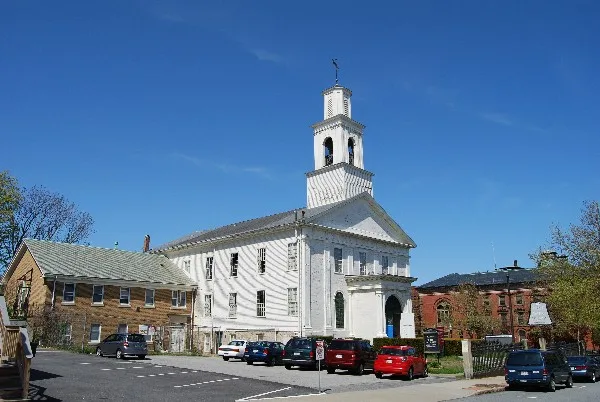
Built in 1829 at 149 William Street in downtown New Bedford, this two-story white clapboard church is an early example of Greek Revival design. It sits on a high stone foundation, with a gable facing the street, six paneled pilasters, a Doric entablature with triglyphs and metopes, and a modillioned pediment. A three-stage steeple rises above the facade. A vestibule and iron fencing were added in 1856, the interior was reversed in 1841, and a brick education building was added at the rear in 1928. The windows still hold original hand-blown glass. The steeple towered over mid-nineteenth-century New Bedford, guided whaling ships returning to port, and appears in the city seal designed in 1847. Congregation members supported the anti-slavery cause in the early 1860s under Reverend John Girdwood. Lieutenant Henry Martyn Robert, a trustee from 1862 to 1865, grew frustrated with a disorderly meeting on the port's defense there, which led to Robert's Rules of Order, published in 1876.
Significance in brief: The church is an early example of Greek Revival church architecture, and its steeple served as a landfall for returning whaling ships and appears in the 1847 city seal. The congregation took part in the anti-slavery movement in the 1860s. Member Henry Martyn Robert wrote Robert's Rules of Order after a chaotic meeting there.
Machine-generated summary. This summary was generated by a language model from the official nomination document and has not been reviewed line by line by an editor. It may contain errors. Check the source document before relying on any detail. Source: nomination document (PDF) · National Archives catalog entry. NRHP reference 75000251, listed April 21, 1975. Summary generated October 2026 (model claude-sonnet-5-5, prompt v1.0-2026-10-29, confidence high).
Key facts
| Address | 149 William St., New Bedford |
|---|---|
| County | Bristol County |
| Listed | April 21, 1975 |
| Reference number | 75000251 |
| Resource type | Building |
| Period of significance | 1829 |
| Architectural style | Greek Revival |
| Areas of significance | Architecture |
| Level of significance | Local |
| Status (as stated in the nomination) | Still in use as a church; exterior in fair condition and interior in excellent condition at the time of nomination. The form says it has been altered and will regain prominence when restored. |
| Acreage | 0.9 |
| Within district | County Street Historic District |
| Coordinates | 41.63514, -70.92833 (NPS GIS) |
What listing means for this property
Religious properties are listed for their architectural or historical significance, not their religious use. Listing is honorary and does not restrict the congregation's use of the building. The federal rehabilitation credit is generally unavailable unless part of the building is income-producing; some state programmes and preservation grants do cover religious buildings. Federal funding or permits trigger Section 106 review.
General information, not legal or tax advice. Rules change; confirm with your State Historic Preservation Office or a qualified adviser.
Sources and further reading
- National Park Service, National Register of Historic Places database (snapshot May 2026), reference 75000251.
- Nomination form (PDF, National Archives) — catalog entry
- Wikipedia article (used for cross-checking only; text not reproduced here)
- Wikidata Q5452415
- This listing as JSON
Last updated October 2026. Found an error? See the editorial policy for how to report it.