Michigan-Wacker Historic District
Also known as: See Also:Jean Baptiste Point Du Sable Homesite

Why it's listed
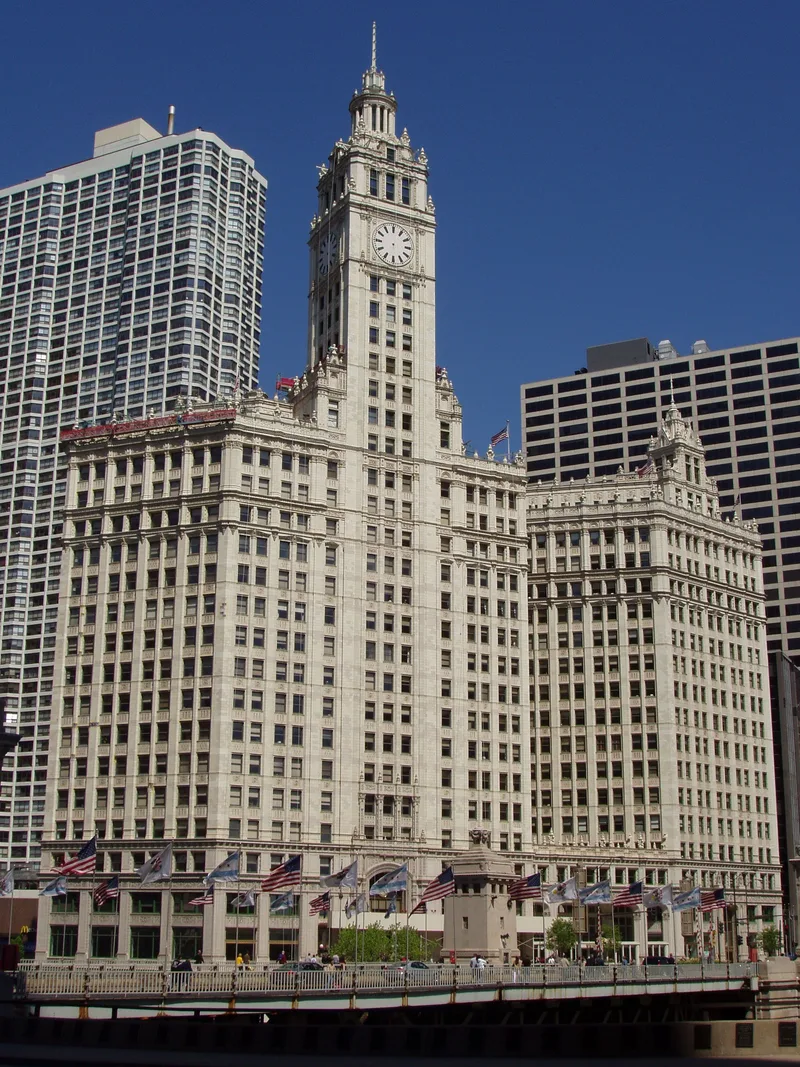
Michigan-Wacker Historic District occupies the northern edge of the Chicago Loop, where Michigan Avenue meets Wacker Drive along the Chicago River. Its 26 structures include eleven significant skyscrapers from the 1920s, among them the Wrigley Building, Tribune Building, Carbide and Carbon Building, 333 North Michigan, and the Chicago Motor Club Building. Taken together they trace a stylistic shift from Gothic and Baroque-inspired designs early in the decade to modern, untraditional forms by 1929. The concentration followed two parts of the 1909 Plan of Chicago: the widening and bi-level redesign of Michigan Avenue, marked by the Michigan Avenue Bridge opening in 1920, and the Wacker Drive riverfront improvement completed in its original portion in 1926. The area was transformed from a decaying street and market district into a prized business location. The district also contains the approximate site of Fort Dearborn, built 1803-12, and the Du Sable homesite, Chicago's first permanent residence, though no remains are visible.
Significance in brief: The district holds a remarkable concentration of 1920s skyscrapers in a small area, which the nomination says is unrivalled in Chicago and probably any other city. The buildings document a shift from historical eclecticism early in the decade to modern design by its close. The concentration resulted from the Burnham-Bennett Plan of Chicago (1909), through the Michigan Avenue Bridge and the Wacker Drive improvement. The district also includes the approximate site of Fort Dearborn and the Du Sable homesite.
Machine-generated summary. This summary was generated by a language model from the official nomination document and has not been reviewed line by line by an editor. It may contain errors. Check the source document before relying on any detail. Source: nomination document (PDF) · National Archives catalog entry. NRHP reference 78001124, listed November 15, 1978. Summary generated October 2026 (model claude-sonnet-5-5, prompt v1.0-2026-10-29, confidence high).
Key facts
| Address | Michigan Ave. and Wacker Dr. and environs, Chicago |
|---|---|
| County | Cook County |
| Listed | November 15, 1978 |
| Reference number | 78001124 |
| Resource type | District |
| Period of significance | 1900- |
| Architect / builder | Multiple, including Howells and Hood; Graham, Anderson, Probst, and White; Holabird and Root; Burnham Brothers; Walter W. Ahlschlager; Alfred S. Alschuler; Edward Bennett; Lorado Taft |
| Architectural style | 1920s skyscrapers ranging from Gothic and Baroque historical eclecticism to non-historical modern |
| Areas of significance | Community Planning and Development, Exploration/Settlement, Architecture |
| Level of significance | National |
| Status (as stated in the nomination) | The district is overwhelmingly commercial with intense land use. The nomination reports no intrusions and notes that the Michigan Square Building was demolished in 1973. |
| Acreage | 29.5 |
| Coordinates | 41.88938, -87.62446 (NPS GIS) |
What listing means for this property
This is a historic district. Buildings within its boundary are either contributing (they add to the district's significance) or non-contributing. Owners of contributing income-producing buildings can claim the 20% federal rehabilitation tax credit; homeowners should look at state credits. National Register districts impose no design review by themselves; a local historic district ordinance, if one exists, does (the difference explained).
General information, not legal or tax advice. Rules change; confirm with your State Historic Preservation Office or a qualified adviser.
Sources and further reading
- National Park Service, National Register of Historic Places database (snapshot May 2026), reference 78001124.
- Nomination form (PDF, National Archives) — catalog entry
- Wikipedia article (used for cross-checking only; text not reproduced here)
- Wikidata Q6837858
- This listing as JSON
Last updated October 2026. Found an error? See the editorial policy for how to report it.